
Reviewed · WALKING TOURS
Barcelona in 2 Hours: Guided Walk Through History and Sights
A first look at Barcelona’s past starts fast. This 2-hour guided walk focuses on the stories behind the Gothic Quarter and El Born, linking art, religion, and Catalan identity from stop to stop. What makes it work is how quickly the route connects big names and big events to what you can actually see on the street.
I really like the tour’s emphasis on meaning, not just photos. Els 4 Gats, the street art photomosaic tied to September 11, 1714, and the martyr story of Eulalia all turn familiar sights into clearer ideas about how locals think and remember. I also like that the guides mentioned in past departures, including Darren and Petra, are praised for clear, lively English and for pointing out details most people miss.
One thing to consider: this is a busy walking route, and on at least one departure the street noise was loud and there was no speaker or audio support. If you depend on hearing every word, I’d bring simple earplugs and plan to ask questions when you can.
In This Review
- Key highlights
- A 2-hour route built for first-day orientation
- Price and logistics: $22.99 that fits a quick plan
- Meeting point to finish: easy walk structure from Gothic Quarter to El Born
- Els Quatre Gats: the Art Nouveau café behind Picasso and Gaudí
- El Mon Neix En Cada Besada: why the mosaic connects to La Diada
- Catedral de Barcelona and Eulalia: Gothic faith with a martyr’s ending
- Casa de l’Ardiaca: Roman remnants inside a Gothic and Renaissance mix
- Pont del Bisbe: a bridge with a legend and a test of your courage
- Placa Sant Felip Neri: a square shaped by Catalan independence grief
- MUHBA – El Call: medieval Jewish Barcelona in narrow lanes
- Placa de Sant Jaume: the seat of government and the feeling of civic power
- Placa del Rei: royal space and the shadow of the Spanish Inquisition
- Plaça de l’Àngel: from grain trading to a saintly apparition rename
- Basilica de Santa Maria del Mar in El Born: maritime Gothic and a big closing impression
- What you’ll actually get from the guide (and what to watch for)
- Should you book? My honest call for the right traveler
- FAQ
- How long is the Barcelona in 2 Hours tour?
- How much does the tour cost?
- Where does the tour start and where does it end?
- Is the tour offered in English?
- Is there a mobile ticket?
- What is included for admissions at each stop?
- How large is the group?
- Can I cancel for free?
Key highlights
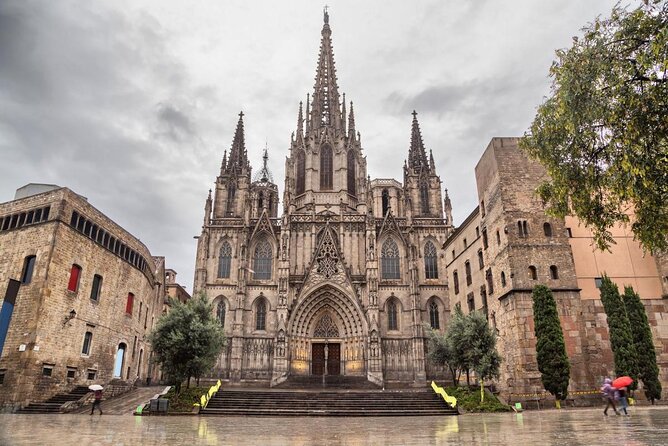
- Els 4 Gats culture link to Picasso and Gaudí through a historic Art Nouveau café and meeting place
- El Mon Neix En Cada Besada street art explained beyond the Instagram shot, tied to September 11, 1714 and La Diada
- Catalan identity woven into the route, with squares tied to independence and civic power
- MUHBA – El Call for medieval Jewish Barcelona and narrow, story-filled lanes
- Roman to medieval layers at Casa de l’Ardiaca, including remnants of walls and an aqueduct structure
- A short, focused format with a maximum group size of 20 people and a handy mobile ticket
A 2-hour route built for first-day orientation
Barcelona can feel like a lot at once. This tour is short on purpose, so you get a structured start without spending your whole day in transit or queue lines. You walk through Ciutat Vella and end in El Born, with each stop timed for quick context and photo opportunities.
I like how the pacing supports your brain. When a guide explains why Eulalia matters, or why a “fun” mural connects to Catalan history, you stop seeing Barcelona as separate postcards. You start seeing it as one connected story told in stone, tile, and street corners.
The route also helps with navigation later. Once you’ve walked these squares and alleys, you’ll recognize the city when you go back out on your own, especially around the Gothic Quarter and the Born area.
More Walking Tours in Barcelona
- Barcelona Tapas and Wine Experience Small-Group Walking Tour
★ 5.0 · 5,804 reviews - Barcelona: Tapas Walking Tour with Food, Wine, and History
★ 4.8 · 4,261 reviews - Barcelona: Food Walking Tour with Tapas and Wine
★ 4.9 · 2,180 reviews - Barcelona Tapas Walking Tour: Food, Wine & History
★ 4.5 · 1,928 reviews
Price and logistics: $22.99 that fits a quick plan
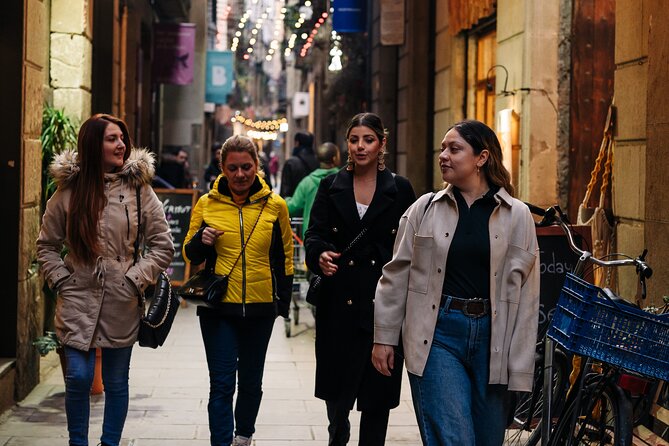
At $22.99 per person for about 2 hours, you’re paying for a guided walkthrough rather than a museum day. You’re not buying “one big attraction,” you’re buying interpretation, route planning, and a guide who connects the dots between places that are close together.
The group size cap of 20 travelers matters more than it sounds. Smaller groups usually mean less time waiting and more chance to ask questions as you walk. You also get a mobile ticket, which keeps things simple when you’re juggling walking and photos.
The main catch is admissions. Some stops are listed with admission tickets free, while Barcelona Cathedral and Basilica de Santa Maria del Mar are not included. You can still enjoy the outside and the guided context, but if you want full entry, you’ll need to plan for those extra tickets.
Meeting point to finish: easy walk structure from Gothic Quarter to El Born
You start at Plaça del Vuit de Març, Ciutat Vella (08002) and end at Basílica de Santa Maria del Mar, Plaça de Santa Maria (08003). Both areas are in central Barcelona, so this tour works well early in your visit when you want orientation but you do not yet know where everything is.
Because it’s near public transportation, it’s also a good “plug-in” experience. If your day has gaps between major sights, you can slot this in without crossing the city on multiple subway changes.
I also like the end point choice. Ending at Santa Maria del Mar puts you in a great spot to keep exploring El Born on foot, with the Gothic atmosphere still fresh in your head.
Els Quatre Gats: the Art Nouveau café behind Picasso and Gaudí
The first stop is Els 4 Gats, a historic café and restaurant known for its Art Nouveau look and its role as a meeting place for creative thinkers. What I like about this start is that it gives you an entry point into Barcelona as a city of artists, not just architecture.
The guide context here matters. You learn how this place was loved by tourists and locals alike, but also why it mattered historically as a gathering spot. The names tied to it, including Pablo Picasso and Antoni Gaudí, make the café feel like more than a storefront.
A possible downside is that this is an early stop and the time is short. You’ll get the story and the exterior design, but you should not expect a slow, café-style hang. Treat it as a launch pad for the rest of the route.
More Spanish cities taken on foot:
- Barcelona: Gothic Quarter Ghosts and Legends Walking Tour★ 4.7 · 1,443 reviews
- Barcelona Helicopter, Sailboat & Old Town Private Walking Tour★ 5.0 · 1,395 reviews
- Barcelona: Old Town and Gothic Quarter Walking Tour★ 4.8 · 1,393 reviews
El Mon Neix En Cada Besada: why the mosaic connects to La Diada
Next you hit El Mon Neix En Cada Besada, the photomosaic that many people spot for its visual impact. The value here is the deeper explanation: it connects to the Catalan defeat on September 11, 1714, an event tied to the celebration of La Diada.
This is where the tour’s real strength shows. Barcelona is full of art that looks decorative until you learn why it exists. Once you understand the political and cultural link, the mosaic stops feeling like a photo prop and starts feeling like public memory.
One practical note: because the time here is about 10 minutes, you’ll want to take photos quickly, then listen closely. The story is the whole point.
Catedral de Barcelona and Eulalia: Gothic faith with a martyr’s ending
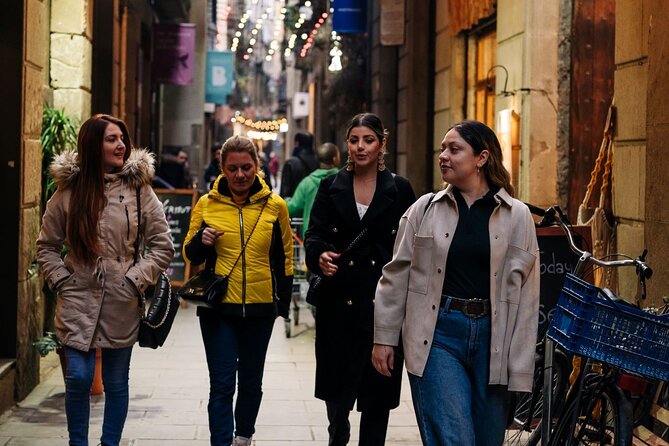
Then the tour turns to Catedral de Barcelona, a Gothic-style church built over centuries. The connection to the city’s identity comes through Saint Eulalia, where the guide explains how her life and death are central to the cathedral’s illustration and story.
The detail that makes it stick is her martyr tale, which the tour frames as part of the city’s religious and cultural backbone. Even if you are not deeply into church history, this stop gives you a human thread for understanding why Eulalia is so visible in Barcelona.
A consideration: admission is not included for the cathedral. So if you want to go inside, plan for a separate ticket. If you do not, you can still learn the story and appreciate the exterior and setting.
Casa de l’Ardiaca: Roman remnants inside a Gothic and Renaissance mix
Casa de l’Ardiaca is a small but powerful stop in the Gothic Quarter. It’s described as a tiny architectural marvel that blends Gothic and Renaissance elements, while also carrying reminders of Roman Barcelona.
The tour highlights Roman-era remnants, including parts of a wall and arcades connected to an aqueduct that once supplied water to Barcino. I love that this turns “old building” into “engineering across time.” It’s not just decorative stone, it’s infrastructure and survival.
Because the stop is short, your best move is to look in layers. Take a second to spot the mixed styles, then listen for the Roman references. That combo makes the site feel far more dimensional.
Pont del Bisbe: a bridge with a legend and a test of your courage
Pont del Bisbe is often cited as one of the most photographed places in Barcelona, and the tour adds the legend tied to it. The guide frames it as a legend that can capture superstitious visitors, while giving skeptics something to think about.
The practical value here is how the guide uses a simple city moment to teach Barcelona’s storytelling style. You learn that local culture often mixes history, religious symbolism, and folklore, even at small scale spots like a bridge.
Time is tight, so keep moving. You’ll want a photo, hear the legend, and then continue while the route is still fresh in your mind.
Placa Sant Felip Neri: a square shaped by Catalan independence grief
This stop is Placa Sant Felip Neri, described as a hidden square with a sombre story linked to Catalan independence. Even though it’s not a “big-name” square like some of the others on the list, the point is how history shows up in ordinary public space.
I like stops like this because they teach you to read the city. Barcelona is often explained through art and museums, but squares like this show how people process loss and identity in the everyday.
If you prefer upbeat pacing all the way through, this is likely the most emotionally heavy moment of the route. It’s short, but it lands.
MUHBA – El Call: medieval Jewish Barcelona in narrow lanes
Then you step into MUHBA – El Call, tied to the medieval district of Barcelona’s former Jewish population. The area is presented as charming, with narrow streets and architecture that helps you picture a much older city inside the modern one.
This stop is valuable because it broadens the “who lived here” story. It reminds you that Barcelona’s identity is not only tied to rulers and cathedrals, it’s also shaped by communities, neighborhoods, and daily life.
Because it’s about 10 minutes, you won’t get a long museum-style walk. But you’ll come away with a mental map of where the old quarters sit, which is handy for later solo wandering.
Placa de Sant Jaume: the seat of government and the feeling of civic power
Placa de Sant Jaume is the main square of the city and it’s presented as both a celebration space and a protest space. The tour explains that it houses seats of the Catalan government and City Hall, so you understand the square as civic theater, not just a postcard.
I love how the guide links the built environment to modern identity. The square becomes a stage where Catalan history and politics still feel alive in how people gather.
Time here is short, so your goal is to absorb the square’s role. Look around, then listen for the story about an important figure connected to celebrations and public emotion.
Placa del Rei: royal space and the shadow of the Spanish Inquisition
Next is Placa Del Rei, described as an imposing square tied to the Royal Palace and a darker chapter in Barcelona’s past. The tour brings in the Spanish Inquisition, giving weight to what you see in stone and street layout.
This stop adds balance. Barcelona’s story can lean too far toward art and romance if you only visit the signature architecture. Here you get a reminder that the city’s power systems and punishments are part of its historical DNA.
If you are the type who gets unsettled by heavy topics, this may be the stop that hits hardest. But in a short tour, it’s also what helps the whole route feel honest.
Plaça de l’Àngel: from grain trading to a saintly apparition rename
Plaça de l’Àngel is another time-limited stop with a strong explanation. It was once called Wheat Square and was used as a grain trading hub. The tour explains that it was renamed when a heavenly apparition appeared during the procession of Saint Eulalia’s body.
That’s the kind of detail that makes you see Barcelona differently. A name change is not trivia here, it’s a clue to how faith and public life blend into city identity.
Practical tip: take your photo, then listen again. The story depends on the sequence, from trade to procession to renaming, and you’ll get more out of it if you follow the logic.
Basilica de Santa Maria del Mar in El Born: maritime Gothic and a big closing impression
The tour finishes at Basilica de Santa Maria del Mar, located in El Born. This Gothic basilica is framed as a staple of the neighborhood and a testament to Barcelona’s maritime history.
What I like about ending here is the mood. The Gothic architecture feels weighty, but the guide framing gives it a citywide purpose, connecting the basilica to how Barcelona built itself as a trading and seafaring power.
Admission is not included for this stop, so again, if you want to go inside, plan on separate tickets. Even without entry, you’ll end with a recognizable landmark and a strong sense of place to continue your day.
What you’ll actually get from the guide (and what to watch for)
This is the kind of walking tour where the guide quality shapes your experience. In the provided examples, guides like Darren, Petra, Jorge, Sonia, Sonja, and Vanessa were praised for being energetic, story-driven, and organized, with clear English.
You also get value in the form of local suggestions. One guide was specifically mentioned for pointing out hidden spots and offering practical recommendations, including a tapas recommendation called Tapas 2254. That kind of added context can help you spend the rest of your time eating and walking like a local.
The tradeoff is attention span. Each stop is around 10 minutes, so you’re not going to stop for long discussions. If you love deep museum-level detail, you might want a follow-up day at a major site. If you want a crisp orientation plus stories, this format is a good match.
Should you book? My honest call for the right traveler
Book this tour if you want a high-impact introduction to Barcelona’s Gothic Quarter and El Born in a tight time window. The strongest reason to go is that the tour connects art and architecture to real events like September 11, 1714 and the stories tied to Saint Eulalia, so you leave with meaning, not just photos.
I would especially recommend it for first-time visitors who feel overwhelmed by Barcelona’s scale. You’ll learn how to read the city, you’ll pick up a route you can reuse for later walks, and you’ll understand why locals talk about Catalan identity with such emotion.
Skip it or plan differently if you need inside access to major churches. Since cathedral and basilica admissions are not included, you may end up wanting separate tickets anyway. Also consider earplugs if you are sensitive to street noise, since at least one departure note mentioned difficulty hearing when a speaker or audio device was not used.
If that sounds like your style, this is an efficient way to get started, and a smart investment at $22.99 for a guided storytelling walk that keeps you moving through the city’s most identity-rich streets.
FAQ
How long is the Barcelona in 2 Hours tour?
It runs for about 2 hours.
How much does the tour cost?
The price is $22.99 per person.
Where does the tour start and where does it end?
It starts at Plaça del Vuit de Març, Ciutat Vella (08002) and ends at Basílica de Santa Maria del Mar, Plaça de Santa Maria, 1 (08003).
Is the tour offered in English?
Yes, it is offered in English.
Is there a mobile ticket?
Yes, the tour offers a mobile ticket.
What is included for admissions at each stop?
Some stops are listed with admission ticket free, while Barcelona Cathedral and Basilica de Santa Maria del Mar are listed as admission not included.
How large is the group?
The tour has a maximum of 20 travelers.
Can I cancel for free?
Yes, there is free cancellation. You can cancel up to 24 hours in advance for a full refund.
More Historical Tours in Barcelona
- Barcelona: 2.5-Hour Bike or E-Bike Historical Tour★ 4.5 · 1,262 reviews
- Barcelona Erotic Museum – Explore Art, History & Fun★ 4.4 · 450 reviews
- Private Jewish Heritage Journey by Barcelona Dreaming★ 4.8 · 383 reviews
- Andorra Original History and Sightseeing Tour (Private, Pickup)★ 5.0 · 350 reviews
- Barcelona: Dark History Night Walking Tour★ 4.8 · 344 reviews
Latest Barcelona reviews into the ledger





Walking Tours, compared.
Barcelona Tapas and Wine Experience Small-Group Walking Tour
Read our review →
Tapas Walking Tour with Food, Wine, and History
Read our review →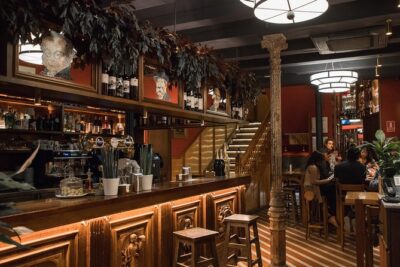
Madrid Tapas & Wine Tasting Walking Tour – Small Group Local Bars
Read our review →
Albaicín and Sacromonte Guided Sunset Walking Tour
Read our review →
Toledo Tour & Vineyard Walk with Wine Tasting from Madrid
Read our review →
Madrid Walking Tour from Puerta del Sol to Retiro Park
Read our review →
Barcelona Tapas Walking Tour: Food, Wine & History
Read our review →Browse the lists this tour appears in