
Reviewed · CITY TOURS
Cordoba City Tour with Mosque-Cathedral from Seville
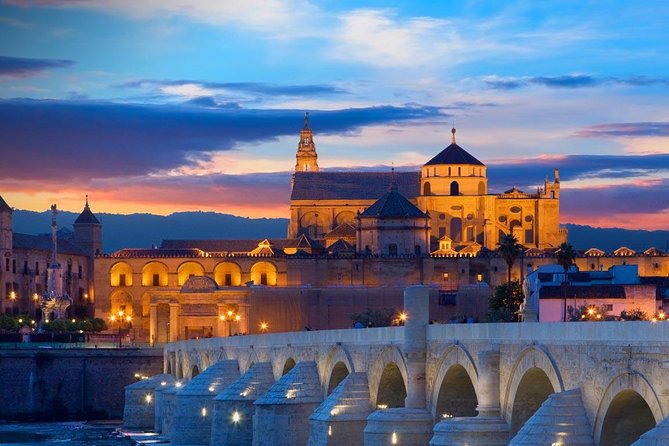
Córdoba feels like time travel from Seville. This day trip strings together UNESCO old town highlights, ending with the Mezquita-Catedral with your entry handled for you.
I especially like the way the morning starts with big, easy-to-follow landmarks, then turns into a guided walk through Cordoba’s Jewish quarter. I also love that you get a ticket-included stop at the flower-filled Los Patios de San Basilio, not just a drive-by photo stop.
One thing to plan for: it’s a long, walking-heavy day on uneven streets, and how much you understand can depend on your guide’s spoken English and the day’s language mix.
In This Review
- Key highlights to look for
- The Seville to Córdoba morning that keeps your day from unraveling
- Calahorra Tower and the Roman Bridge, your fast start in old town
- Los Patios de San Basilio: why the courtyard stop feels like a reset button
- La Judería and the Cordoba Synagogue, the quarter you can’t rush
- Entering the Mezquita-Catedral: the design that stuns even first-timers
- After the big sights: how to use your Córdoba free time well
- The Roman Bridge, water wheel, and why the lesser stops still count
- Price and logistics: is €119.47 a fair deal?
- Group size, walking pace, and who this tour suits best
- Picking the right guide moment: what to watch for during the Mezquita-Catedral
- Should you book this Córdoba day trip from Seville?
- FAQ
- How long is the Córdoba tour from Seville?
- What time does the tour start?
- What is included in the price?
- Is food included?
- Do I get skip-the-line entry for the Mosque-Cathedral?
- What language is the tour offered in?
- When does the tour end?
- Can I cancel for a full refund?
Key highlights to look for
- Skip-the-line access to the Mosque-Cathedral (Mezquita-Catedral), so you spend less time stuck at the entrance
- Los Patios de San Basilio ticket included, with a rare look at courtyard life
- Judería focus with the big names of the quarter, plus a visit to the Cordoba Synagogue (note the weekly closure)
- Layer-by-layer architecture at the Mezquita-Catedral, from Islamic design to later Christian additions
- Guided walking, then true free time, so you can pace yourself with lunch, shopping, and extra sights
- Round-trip transfers by air-conditioned coach, designed to save you the hassle of train timing
The Seville to Córdoba morning that keeps your day from unraveling
This tour starts with a 9:00 am departure from Seville by air-conditioned vehicle. You trade the stress of train schedules for a single plan, plus onboard live commentary as you head east through Andalusia. It’s a good way to “wake up” to Cordoba before you even arrive, because the city is best understood as layers, not as one single monument.
I like that the guide work begins right away with context: Cordoba grew into one of Europe’s biggest cities during the 10th century, with hundreds of thousands of people moving through its streets. Founded by the Romans, it later became a major Moorish center between the 8th and 13th centuries, which is exactly why you still see Islamic-era architecture at street level.
One practical point: this is a full-day plan, about 10 hours. If you’re prone to getting cranky after long rides and walking, pack for it, not for a relaxed city stroll.
More Things to Do in Seville
- Seville: Royal Alcázar Entry Ticket
★ 4.6 · 28,378 reviews - Seville: Live Flamenco Dancing Show Ticket at the Theater
★ 4.7 · 16,396 reviews - Seville: Alcázar, Cathedral & Giralda Skip-the-Line Tour
★ 4.8 · 11,525 reviews - Seville: 1-Hour Guadalquivir River Sightseeing Eco Cruise
★ 4.2 · 10,281 reviews
Calahorra Tower and the Roman Bridge, your fast start in old town
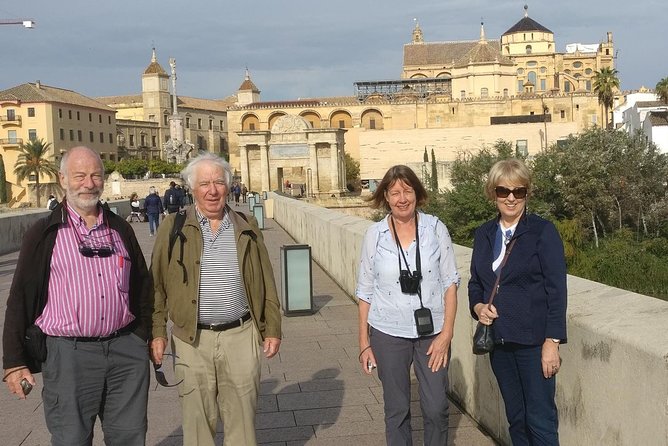
Your group begins with a walking introduction that centers on the Calahorra Tower and the Roman Bridge. The tower sits like a landmark anchor by the river, and the Roman Bridge gives you that instant “I’m in the right place” feeling. Even if you have seen photos of these spots, seeing them in person sets the scale for what comes next.
This first stretch also helps with orientation. Old Córdoba is a maze, and a guiding hand early on makes it easier to connect what you see to what you’re being told. The tone here is simple: look, understand, keep moving.
A detail that can add interest while you walk: you’ll pass the Royal Stables, built in 1570 by King Philip II. It’s not the main attraction for most people, but it’s a nice reminder that Cordoba’s story didn’t stop at the medieval Islamic era.
Los Patios de San Basilio: why the courtyard stop feels like a reset button
One of the best included breaks is the visit to Los Patios de San Basilio. You’ll admire courtyards that participate in Cordoba’s famous patio tradition, a yearly competition that draws crowds. For many visitors, this is the moment the city stops feeling like a list of monuments and starts feeling like daily life.
Courtyards in Cordoba are built for shade, plants, and social space, and the patio stop makes that clear. You can see how the homes work with the climate, not against it. And because it’s a ticket-included stop, it saves you the “should I buy this?” moment when you’re tired.
The only drawback is time. Courtyards are compact, and the visit window can feel short if you’re the type who wants to linger. Still, it’s usually a far more memorable photo stop than yet another viewpoint.
La Judería and the Cordoba Synagogue, the quarter you can’t rush
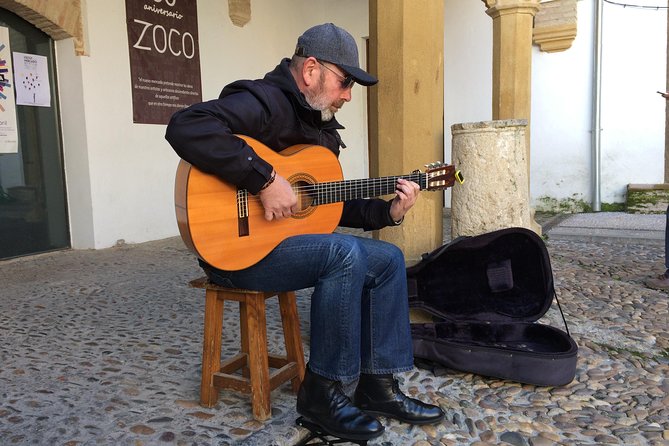
After the patios, your walking route takes you into La Judería, the old Jewish quarter. This is described as the largest in Europe, and the streets live up to that reputation. Narrow lanes, small squares, and the sense of a neighborhood rather than a museum help the guide’s explanation land.
You’ll walk past places tied to major historical figures and stories, including references connected to Maimonides. Even if you don’t know every name before you go, the guide gives you enough context to understand why the quarter mattered for Cordoba’s prosperity during the Middle Ages.
Then comes the Cordoba Synagogue, the only original Jewish synagogue preserved in Andalusia. You’ll see Mudejar-style plasterwork inside, which is a key visual clue for how cultures influenced one another in different eras. The important consideration here: the synagogue is closed on Mondays. If your tour date falls on Monday, you’ll want to remember that this portion may not match your expectations.
A few more Seville verdicts worth reading
- Seville: City Sightseeing Hop-On Hop-Off Bus Tour★ 4.0 · 4,633 reviews
- Seville: Highlights City Bike Tour★ 4.8 · 2,168 reviews
- City Sightseeing Seville Hop-On Hop-Off Bus Tour★ 4.0 · 1,782 reviews
Entering the Mezquita-Catedral: the design that stuns even first-timers
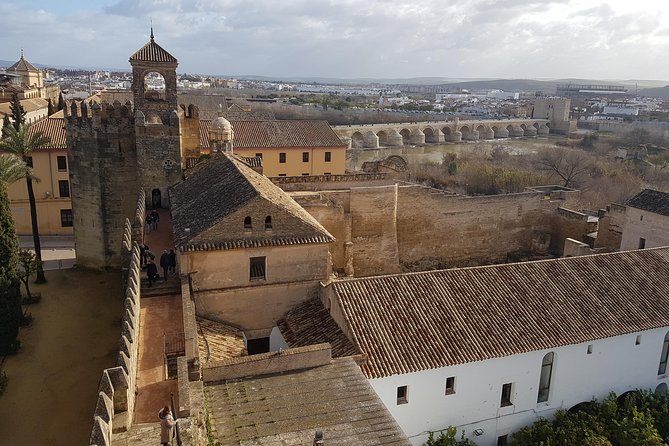
The highlight is the Mezquita-Catedral, sometimes called the showpiece of Cordoba’s UNESCO-listed center. You’re looking at one of the most significant monuments in the western Islamic world, and what makes it unforgettable is the architectural “rewrite” over time.
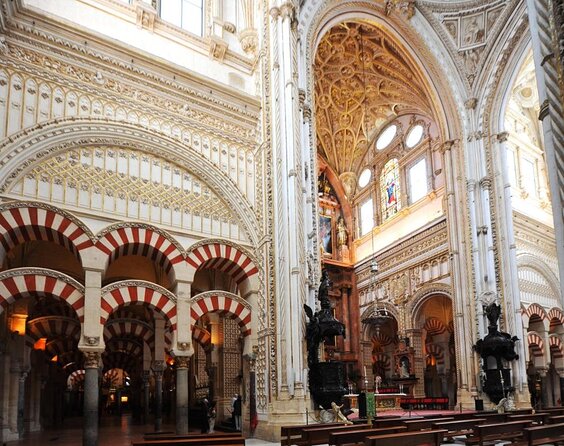
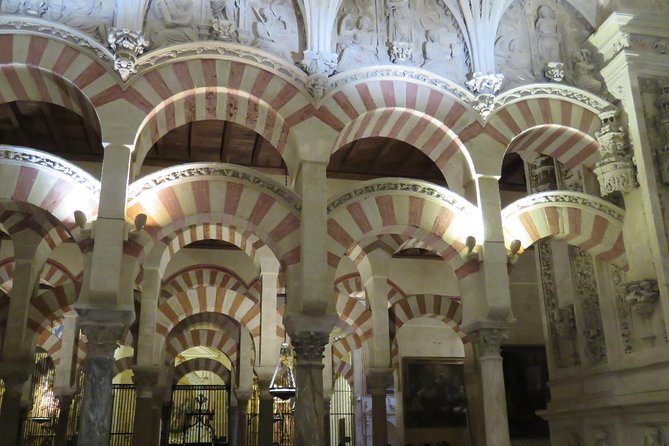
When you step inside, focus on the red-and-white archways. The look is often described as resembling a palm grove, and that comparison is more than a slogan once you’re standing under the rows. The building’s Islamic roots are clear in the rhythm, the repetition, and the way light moves through the interior.
Also pay attention to the courtyard and the bell tower. These aren’t “extras.” They help you read the building as a complex designed for worship and community, then later adapted. The mihrab, with its horseshoe-shaped form, is the prayer niche that turns the space into a purposeful direction, not just decoration.
A useful detail: you’ll have a choice for how to experience the interior, with an option for an audio or self-guided tour. That matters because a guided explanation can’t always cover every inch. If you like to slow down, this is your chance to do it.
One consideration to keep in mind, based on what people often feel about this kind of big monument stop: if you expect long free roaming time inside the Mezquita-Catedral, do not assume you’ll get it automatically. Your experience can depend on how your group moves and how your guide paces the story.
After the big sights: how to use your Córdoba free time well
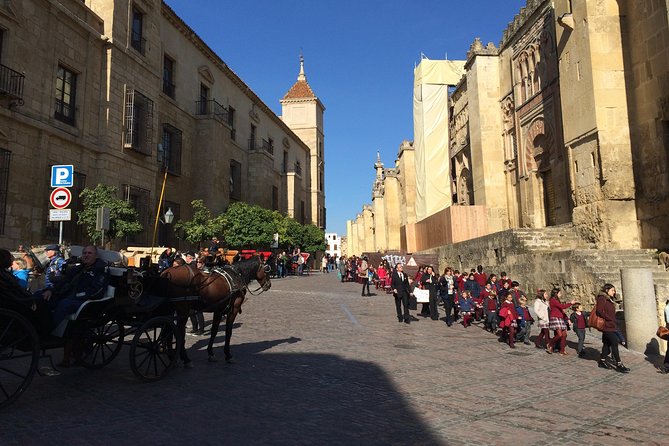
Once the main monuments are covered, you get time to explore and relax independently. This is where you decide what kind of Córdoba you want. If you’re hungry, plan lunch on your own expense. If you like photos, wander slowly, because you’ll spot details that you miss at tour speed.
If you want a simple strategy, I recommend using the free time for one of these:
- A long, meandering loop through side streets where you can stop whenever something catches your eye
- A second look at the areas that felt confusing earlier, now that you have orientation
- Shopping for souvenirs without rushing, since you’re not being pulled into the next timed stop
If it’s a hot day, treat breaks as part of the plan. Cordoba can feel intense in daylight, and resting helps you enjoy the evening vibe instead of just surviving it.
The Roman Bridge, water wheel, and why the lesser stops still count
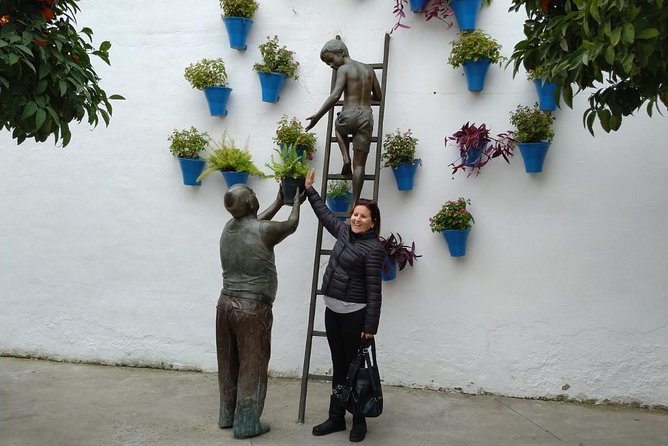
Even beyond the headline sites, the itinerary tries to show you what made Cordoba run. You’ll see the restored Albolaifa water wheel on the Guadalquivir, tied to a 9th-century tradition of moving water. It’s an easy stop to skip when you only care about famous buildings, but it’s actually a smart reminder that cities are built on systems, not only on monuments.
It also ties back to the theme of layered Cordoba. Islamic-era urban planning and daily needs shaped where people lived and how they worked. When you connect the water infrastructure to the neighborhood feel of the Jewish quarter and courtyards, the city starts to make sense as a functioning place.
Price and logistics: is €119.47 a fair deal?
At $119.47 per person for about 10 hours, this is not a cheap day trip. But it also isn’t just a bus ride. You’re paying for:
- Round-trip coach transfers from Seville
- Driver and professional guide
- Live onboard commentary
- Skip-the-line ticket for the Mezquita-Catedral
- Included admission for Los Patios de San Basilio
- Included admission for the Cordoba Synagogue
When you price it out mentally, the included tickets and the skip-the-line handling do real work for your time. The Mezquita-Catedral is a place where waiting can eat your morning, so “managed entry” is a genuine value feature, not a marketing gimmick.
Food and drinks are not included, so you should budget for lunch and water. If you don’t, you’ll feel the trip cost creep up. For the rest, this is a pretty tidy setup for one full day.
Group size, walking pace, and who this tour suits best
The group has a maximum of 55 travelers. That’s big enough to feel busy at crowded monuments, but small enough that you usually stay with the guide. You’ll also be walking on historic streets, which can mean cobbles and uneven footing.
This is the tour I’d recommend most if you:
- Enjoy guided context, especially for a major monument like the Mezquita-Catedral
- Want a single-day “greatest hits” route, plus courtyard time
- Are comfortable walking for a large chunk of the day
- Like the idea of a guided morning, then self-paced exploring in the afternoon
If you have mobility issues or struggle with long walks and cobbled streets, you should think carefully. Multiple people note that the walking can be tiring, and that older guests can feel rushed in tight spaces.
Also, language clarity matters. Even though the tour is offered in English, some days can include a mixed-language group. If you are sensitive to accents or audio, you may want to mentally prepare for some switching. People often praise guides like Carlos and Antonio for making the Mezquita-Catedral story click, including the way they explain how the Islamic and Christian parts fit together.
Picking the right guide moment: what to watch for during the Mezquita-Catedral
Your guide is the difference between a good tour and a “wow” day. Strong guides tend to explain the building as an evolution, not as random decoration. Several named guides in the experience category are repeatedly singled out for clear pacing and helpful detail, including Carlos, Antonio, Jesus, Juanra, and Josė.
Here’s what to watch while you’re inside:
- If the guide points out the arch pattern early, you’ll enjoy the whole interior more
- If they help you find the mihrab and explain why it matters, the space feels intentional rather than overwhelming
- If they give you enough time to go back through areas on your own, you’ll get to see it twice, which is how this monument really sinks in
If your group is large and sound is imperfect, don’t fight for comprehension in every sentence. Instead, pick three things to focus on and let the rest be a bonus. The building is doing most of the teaching.
Should you book this Córdoba day trip from Seville?
Book it if you want the best way to get from Seville to Córdoba without logistics headaches, and you’re excited to see the Mezquita-Catedral plus the Judería highlights in one structured day. The included courtyard visit and synagogue ticket make the day feel fuller than a simple “one monument” tour.
Skip it or rethink it if you want a slow, low-effort day. This plan is long, and the walking is part of what makes it work. Also, if you know you struggle with hearing accents or you prefer a strictly English experience without any switching, ask the operator ahead of time how language handling works on your date.
If you’re on the fence, this is my shortcut decision rule: if you’re the type who loves reading a city through its different layers, you’ll be happy with this route. If you want mostly free time and minimal walking, look for a shorter or smaller-group option.
FAQ
How long is the Córdoba tour from Seville?
The trip is listed at about 10 hours.
What time does the tour start?
The start time is 9:00 am, with morning pickup by air-conditioned vehicle from the Seville hotel area.
What is included in the price?
Included are the driver and professional guide, live onboard commentary, a skip-the-line ticket for the Mezquita-Catedral, admission to Los Patios de San Basilio, and admission to the Cordoba Synagogue.
Is food included?
No. Food and drinks are not included.
Do I get skip-the-line entry for the Mosque-Cathedral?
Yes. A skip-the-line ticket for the Mezquita-Catedral is included.
What language is the tour offered in?
It is offered in English.
When does the tour end?
The tour ends back at the meeting point in Seville.
Can I cancel for a full refund?
Yes. You can cancel up to 24 hours in advance for a full refund.
Latest Seville reviews into the ledger



City Tours, compared.



City Sightseeing Barcelona Hop-On Hop-Off Bus Tour: 24 or 48-Hour
Read our review →

Palma de Mallorca: City Sightseeing Hop-On Hop-Off Bus Tour
Read our review →
Granada City Train 1 or 2-Day Hop-On Hop-Off Ticket
Read our review →
Browse the lists this tour appears in