

Reviewed · VIP
Fuerteventura: The Panoramic VIP island Tour. All HOTSPOTS!
A small group day of big Fuerteventura energy. You get pulled from Puerto del Rosario into dunes, caves, and hilltop miradors, with a local guide named Pepe or Pierre often leading the storytelling. I like the small group size (max 8), because the bus feels calm and the stops actually work. I also love the mix of geology plus panoramas, from Ajuy Caves to sky-friendly viewpoints like Sicasumbre. One thing to consider: the day is not for people who need very frequent toilet access, and it is not suitable for motion sickness.
This is built for “slow tourism.” You ride in an air-conditioned minibus, you get multiple photo stops, and you get free time in old towns instead of sprinting. The tradeoff is simple: each “big point” has limited time, and a few places depend on weather, so not every optional add-on will happen every day.
In This Review
- Key highlights you will feel fast
- Getting picked up from Puerto del Rosario, then heading into the mountains
- Corralejo dunes and the beach-breath of the north coast
- Ajuy Caves walk: 100 million years in your footsteps
- Betancuria old town: cathedral views, coffee breaks, and easy wandering
- Mirador Guise y Ayose: statues, a 669 meter viewpoint, and quick photo lines
- Las Peñitas ravine and its green oasis in the desert
- Sicasumbre: sky watching and viewpoint facilities
- Vallebrón protected area: a ridge, knife-shaped relief, and deep ravines
- Vega de Rio Palmas and the Virgin de la Peña connection
- Tindaya: the witches legend and petroglyph-country views
- Pájara, the Hermitage of Nuestra Señora de la Caridad, and the Unamuno monument
- Tefía prison colony and the darker side of the island’s 20th century
- Driving the north capital story into Puerto del Rosario
- How this tour handles time, weather, and the small “not guaranteed” items
- Price and value: is $95.58 a fair deal for 6 to 7 hours?
- Who should book this panoramic VIP day on Fuerteventura
- Should you book this tour?
- FAQ
- How long is the Fuerteventura Panoramic VIP island Tour?
- Where does the tour start, and what time does it begin?
- How much does the tour cost?
- Is pickup offered?
- What language is the tour offered in?
- How many people are on the tour?
- Are there entrance tickets included?
- Is lunch included?
- Is the tour suitable for motion sickness?
- What is required for the tour to run?
- Can I cancel for free?
Key highlights you will feel fast

- Max 8 travelers on a new, air-conditioned minibus, so the day stays relaxed.
- Corralejo dunes and the chance to swap in optional nearby beach time if conditions are right.
- Ajuy Caves walk tied to the island’s origins, including Cretaceous-era geology.
- Multiple miradors in one route, including Guise y Ayose, Las Peñitas, Sicasumbre, and Vallebrón.
- Tindaya and Majos legends, plus views from “high house” country.
- Local culture stops that range from Betancuria’s old streets to Tefía’s prison-colony story.
Getting picked up from Puerto del Rosario, then heading into the mountains
Your day starts at 9:15 am, usually with pickup offered for hotel guests and cruise passengers. Expect a message by email or WhatsApp to confirm your exact pickup time and spot. That matters, because this is a timed loop across the island, not a free-for-all road trip.
You will ride in a newer air-conditioned minibus, and the experience is explicitly designed as no stress, with numerous stops and historical context along the way. The “VIP” part here is not velvet ropes. It is fewer people, selected stops, and enough time to look around without feeling like you are being herded.
Good to know upfront: there is no pickup for the far south Jandia area (like Costa Calma and Moro Jable). Also, the tour is listed as not suitable for motion sickness, and animal allergies are a concern.
A few more Fuerteventura verdicts worth reading
- Morro Jable: Dolphin & Whale Watching Cruise, Drinks & Swim
★ 4.1 · 4,158 reviews - Fuerteventura: Cofete Beach Jeep Safari
★ 4.5 · 2,248 reviews - Fuerteventura: Magic Catamaran Trip with Food and Drinks
★ 4.5 · 1,504 reviews - Fuerteventura: Lobos Island Round-Trip Speedboat Ticket
★ 4.8 · 1,473 reviews
Corralejo dunes and the beach-breath of the north coast
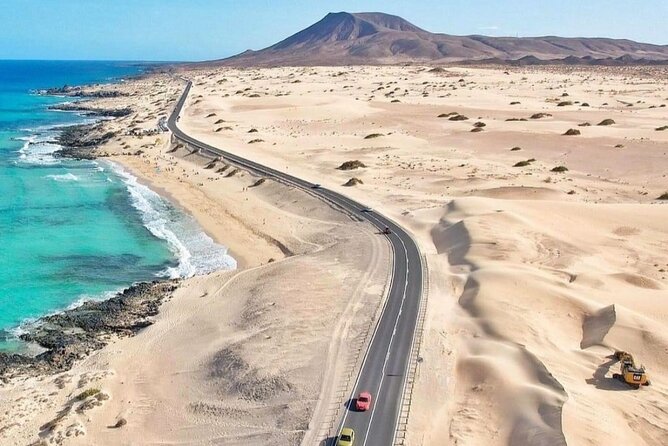
The first major stop is Corralejo, specifically the Dunas de Corralejo area. This is your early “wow” moment, because the island flips from roads and towns into sand and sky. If the weather is nice, the tour may pause for Corralejo beach time too, with a mention of popcorn beaches as an alternative.
Corralejo is often talked about like it is the door to paradise, and after you step out near the dunes, you get why. The coast here feels open, wind-swept, and very Canary Islands. It is also a great place to take photos in softer morning light before the day gets hotter and higher up in the interior.
Time is short, about 10 minutes, so treat it like this: take your photos, then walk a bit toward the best view line you can find. If you are hoping for a long beach sit-down, this is not that stop. It is a taste, and a route opener.
Ajuy Caves walk: 100 million years in your footsteps
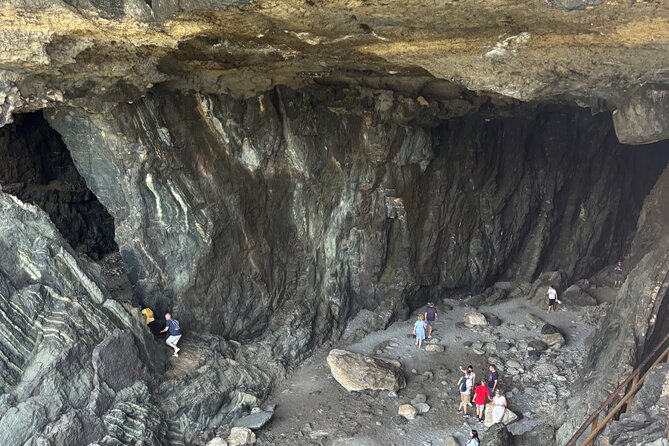
Next comes Playa de Ajuy and the Ajuy Caves walk. This is one of the most meaningful stops on the day because it is not just scenery. The caves are described as the oldest formations in the Canary Islands, tied to how the island formed from submarine lava and sediment rising up about 100 million years ago, in the Cretaceous period.
You walk into a place that feels like a time machine. Even if you are not a geology nerd, the guide’s explanation helps you connect what you see to what it means. You also learn that these rocks emerged from great depth and became part of the base that supports Fuerteventura and Lanzarote.
There is also the human layer, which adds a strong “story” dimension. Ajuy is said to be where Jean de Béthencourt, the conqueror of the Canary Islands, landed in the 15th century. That is an instant bridge between deep time and actual history.
A weather note matters here. If conditions permit, you may also visit caves on the west sea coast. The admission ticket for the main caves visit is included, and the stop is around 45 minutes, which feels about right for both walking and absorbing the guide’s context.
Betancuria old town: cathedral views, coffee breaks, and easy wandering
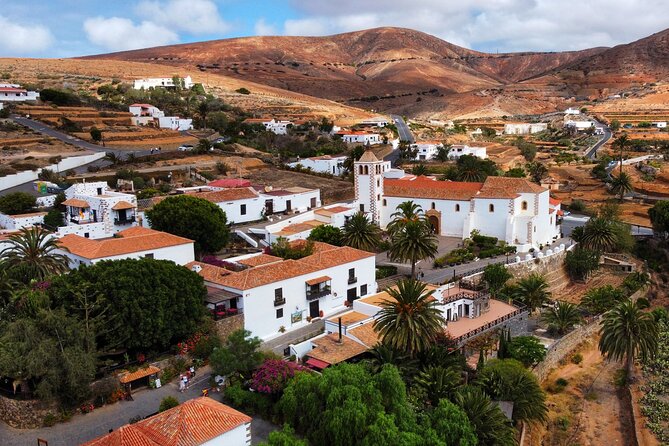
After the geology, you switch gears to Betancuria, an old town setting where history is literally in the streets. You get free time to stroll, browse, and reset before the next string of viewpoints.
If you want the Santa Maria Cathedral, plan on paying the small ticket fee if it is open. The tour gives you the option, not a forced stop. You can also do the very Canary thing here: coffee break, slow chat, and a quick look around for the best angles of old stone and quiet lanes.
The stop is about 30 minutes. That makes it ideal for a short walk loop, not for a long museum-style visit. Use the time for orientation. Betancuria helps you understand the island beyond coastlines, and it sets up the later mountain viewpoints.
Fuerteventura, continued down the scoresheet:
- Fuerteventura: Cofete Beach and “Villa Winter” Tour★ 4.8 · 1,436 reviews
- Fuerteventura: Glass Bottom Boat Cruise with Lunch & Drinks★ 4.4 · 1,317 reviews
- Fuerteventura: Jandía Natural Park & The Puertito Buggy Tour★ 4.3 · 1,263 reviews
Mirador Guise y Ayose: statues, a 669 meter viewpoint, and quick photo lines
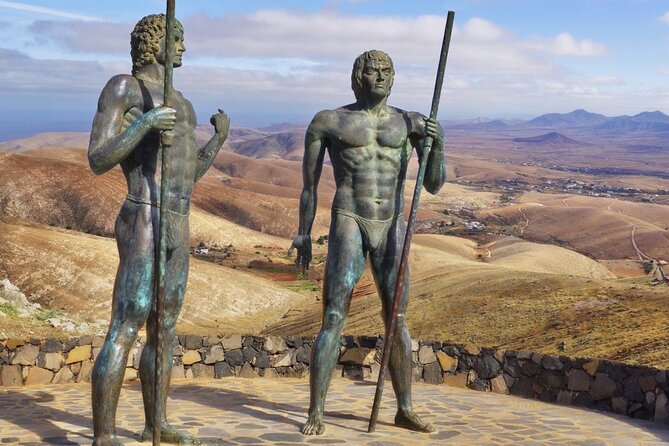
This stop is all about a fast, punchy panorama. Mirador Guise y Ayose sits high, about 669 meters, in mountain country, and it is also known for the two statues of the Guise and Ayose characters. Even if you only catch the view for 10 minutes, you will feel the difference. The air gets cooler. The island looks wider. The roads make sense.
This is a great place for a “stand still and let your eyes adjust” moment. Then grab your photos and move on. The tour keeps you moving on purpose, because the next viewpoints stack up.
Las Peñitas ravine and its green oasis in the desert
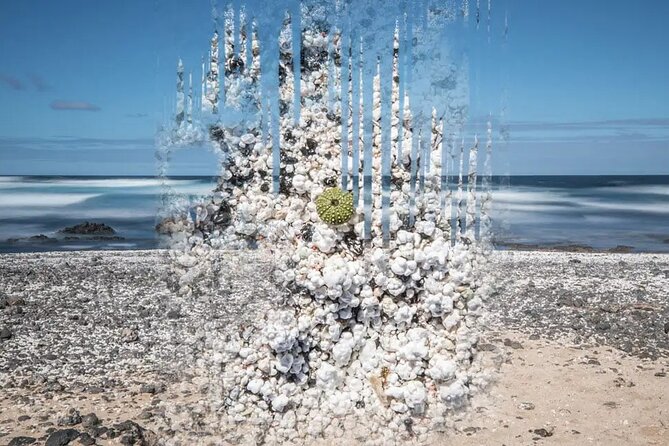
Mirador de las Peñitas is one of those spots that makes you pause, because it feels like the island pulled off a magic trick. From the viewpoint, you see a green oasis in the middle of desert country.
The key detail is the underground river that forms a small lake, created by human hands in 1937. The guide’s explanation turns the scenery into something tangible. You are not just looking at pretty contrast. You are seeing how water and engineering shaped where life can survive.
The viewpoint also has an open esplanade that is made for photos. It is friendly for people who want to step out, take pictures, and not immediately feel rushed. The stop is short, about 10 minutes, but the view is strong enough that 10 minutes can still feel like it hit.
A fun extra note from the tour description: the area is described as home to chipmunks. If you are lucky, you might spot them doing what chipmunks do, ignoring everything except snacks and chaos.
Sicasumbre: sky watching and viewpoint facilities
Driving south, you hit Mirador Sicasumbre at about 300 meters above sea level. This stop is framed as one of the best places on the island to observe the sky. The guide notes that you will stop here when the weather is favorable, and the area has facilities and signage, which makes it easier to work your camera angle.
You also get a simple payoff: this is not just a look-out. It is a viewpoint designed for visitors. That means you can spend the allotted time making the most of what is in front of you, instead of figuring out where to stand.
Time here is around 15 minutes, and admission is included. If you are the type who likes to plan photo angles, you will probably enjoy this one the most.
Vallebrón protected area: a ridge, knife-shaped relief, and deep ravines
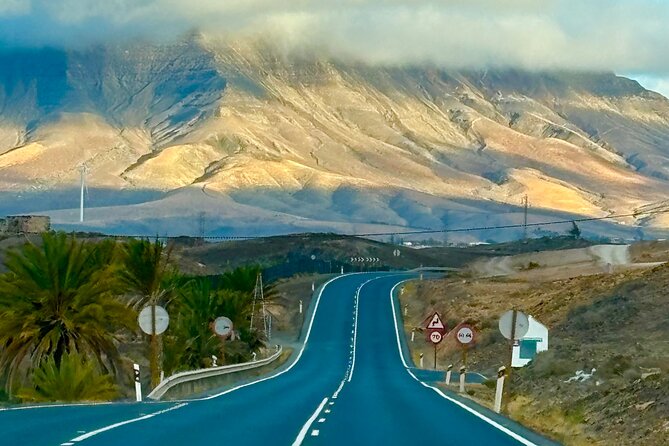
Mirador de Vallebrón is the next “big view” stop, and it is described as part of a protected area between La Oliva and Puerto del Rosario. The details are very specific: an elongated ridge with a knife-shaped relief, flanked by two large U-shaped ravines called Valle Largo and Valle Chico.
This is one of those viewpoints where the island’s shape is the main attraction. You look down and realize the island is built like a sculpted model, not a random collection of roads and hills.
The tour adds a historical hook too. The southern point of the ridge lines up with Montaña de la Muda, tied to an archaeological site. In the distance you can also see nearby towns and mountains like Tindaya and Montaña Quemada, depending on conditions.
Time is about 15 minutes when weather allows. Again, you get enough to appreciate the form, but not enough to wander for a long hike. If you want trails, you will need to plan extra time outside this tour.
Vega de Rio Palmas and the Virgin de la Peña connection
After the ridges, you shift into more cultural and religious stops. Vega de Rio Palmas is mentioned as known for the film Exodus, Gods and Kings, and also for the Church of Virgin de La Peña, described as the patrona of Fuerteventura.
This is a short stop, about 10 minutes, but it is a good “anchor.” It gives you context for why the island’s towns and villages look the way they do, and it ties location names to stories you might otherwise miss.
Right after, you have the Ermita de la Peña Trail possibility. If time is enough and the church is open, the tour may visit the Ermita de la Peña itself. Either way, the guide explains what the Virgin de la Peña means locally, which makes these stops more than quick photo breaks.
Tindaya: the witches legend and petroglyph-country views
Tindaya is where the tour leans into legend. The stop centers on La Casa Alta, described as the high house in Tindaya, linked to stories about witches of Tindaya tied to ancient rituals performed by the Majos.
You get the legend in plain terms: the mountain is framed as a place of magic and sacred power, with stories of what happens at night and who seeks refuge at sunrise. It is more folklore than itinerary checkbox, and the guide’s storytelling makes it feel alive.
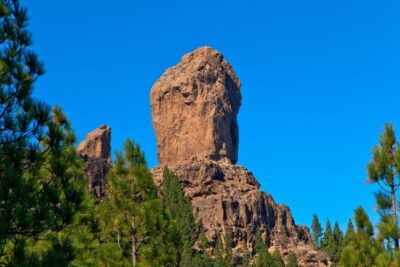
Tindaya also has a scientific side. Mount Tindaya is described as a Natural Monument due to its geomorphological importance and archaeological values, including petroglyphs, plus a sacred character given by the Majos. Rare endemisms are also mentioned, such as Caralluma burchardii.
Time is short, about 5 minutes in the description. So your goal here is quick orientation: look at the mountain, catch the feeling of place, then let the guide’s story do the work.
Pájara, the Hermitage of Nuestra Señora de la Caridad, and the Unamuno monument
Later in the day, the route passes through Pájara, described as one of the first settlements founded by farmers and fishermen because of fertile land and water. The name is said to likely come from the Spanish word for bird, possibly referencing birdlife, and it is also linked to a hen pheasant shown on the coat of arms.
There is also a dramatic historical note: Pájara survived the Arab invasion of 1593, while Betancuria was reduced to dust. That gives the town a strong sense of endurance.
The tour then highlights the Hermitage of Nuestra Señora de la Caridad as the village’s striking monument, declared an Asset of Cultural Interest. There is also mention of a monument honoring Miguel de Unamuno at a spot about 3 km south of the city, at the foot of Mount Quemada.
These are not always “stand in a line and wait” stops. They are better when you use the time to connect names on signs to the stories you are hearing.
Tefía prison colony and the darker side of the island’s 20th century
One of the most sobering parts of the day is a stop by Tefía, described as an agricultural prison colony during the Franco dictatorship. The information provided says it served as a concentration camp for prisoners between 1954 and 1966, including ordinary and political prisoners, and that it was used for the re-education of male homosexuals.
The tour also notes that Tefía was where the first airport (1930) was, and where the first tourists arrived.
If you are looking for a day that is all sunshine, this is the part where you feel the weight. And that is also why it is valuable. You leave with a more complete island picture, not just postcard angles.
Driving the north capital story into Puerto del Rosario
The day continues with a sense of how the island’s “center” moved over time. The tour notes Puerto del Rosario as the island capital from 1834, replacing Betancuria, until the capital moved again to Puerto del Rosario city in 1860.
You also get a pass by the young capital (1862), moving through the center and along the island’s most important port in Fuerteventura. If you have time, there is a photo stop at the port and mention of Playa Chica beach.
There is even a natural feature check. On high tide, you might see the natural swimming pool of the El Charco neighborhood in Puerto del Rosario.
This late-day portion is a nice contrast to earlier mountain views. It grounds the story in the present, where people live, work, and ship goods out to the wider world.
How this tour handles time, weather, and the small “not guaranteed” items
A key reality: the tour’s best stops are stacked far apart, so time is always tight at the top points. This is not a slow walking tour with long waits at viewpoints. You will usually get quick photo windows plus guided context, then you move on.
Weather also affects what you see. The caves add-on and the popcorn beach option in Corralejo are dependent on conditions. Mirador stops like Las Peñitas, Mirador Sicasumbre, and Vallebrón are also described as stops you do when weather allows.
Also, keep an eye on ticket extras. Betancuria’s Santa Maria Cathedral is optional and listed as a ticket you pay if open. So if cathedral photos are your top goal, be ready with that small extra cost.
Finally, toilet timing can be a real factor in this style of route. The information and feedback around the tour suggest mountain travel can make toilet stops harder to find quickly, though the guide tries to help if you ask.
Price and value: is $95.58 a fair deal for 6 to 7 hours?
At about $95.58 per person for 6 to 7 hours, this tour lands in the “good value if you like variety” category. Here is why.
You get hotel or cruise pickup, an air-conditioned minibus, and a local multilingual guide. The group size is capped at 8, which usually means less waiting and more attention during stops. You also get numerous stops plus guided history, not just a sightseeing drive.
On top of that, several stops include admissions, like the Ajuy Caves visit and some viewpoint stops. Others are free or optional, like shopping time and cathedral access. And lunch is positioned as a stop in a local Canarian village on the beach, but lunch itself is not included.
So the value math looks like this: you pay for convenience, guidance, and tight planning across a big island, plus admissions where the tour can make them happen. If you only want one or two places, you might be better off doing a rental car route. If you want an overview plus meaningful stops in one day, this price starts to feel fair.
Who should book this panoramic VIP day on Fuerteventura
You will probably love this if:
- You want the big north and inland highlights without organizing transport yourself.
- You like photo stops and short “let’s make it meaningful” guided explanations.
- You value a small group vibe, and you prefer a relaxed pace over rushing between places.
It might not be the best choice if:
- You need frequent toilet access for medical reasons.
- You have motion sickness concerns, since it is a minibus route through mountains.
- You have animal allergies, since service animals are mentioned as allowed but that does not remove the reality of exposure risk.
- You are staying in areas south of Jandia where pickup is not offered.
Should you book this tour?
Book it if you want a focused day that mixes dunes, caves, old towns, and multiple miradors, with a local guide telling the stories behind the views. The small group size and the number of major stops within the time window are the big strengths.
Skip or adjust expectations if you need long stays at each “wow” point, because most stops are short by design. Also, be ready for optional items to change with weather, and plan for small extras like cathedral tickets if you choose to go in.
If your goal is to get your bearings fast on Fuerteventura, this is a strong way to do it.
FAQ
How long is the Fuerteventura Panoramic VIP island Tour?
The duration is about 6 to 7 hours.
Where does the tour start, and what time does it begin?
It starts in Puerto del Rosario, with a start time of 9:15 am.
How much does the tour cost?
The price is $95.58 per person.
Is pickup offered?
Yes. Pickup and drop-off are offered for hotel & cruise guests.
What language is the tour offered in?
The tour is offered in English.
How many people are on the tour?
The tour has a maximum of 8 travelers.
Are there entrance tickets included?
Some stops include admission ticket access, such as the Ajuy caves walk. Other places like Betancuria’s Santa Maria Cathedral can require a small extra ticket if you want to visit.
Is lunch included?
Lunch is not included, though there is a lunch stop in a local Canarian village on the beach.
Is the tour suitable for motion sickness?
No, it is not suitable for travelers with motion sickness.
What is required for the tour to run?
It requires good weather. If it is canceled due to poor weather, you will be offered a different date or a full refund.
Can I cancel for free?
Yes, you can cancel up to 24 hours in advance for a full refund. If you cancel less than 24 hours before, the amount paid is not refunded.
Latest Fuerteventura reviews into the ledger


VIP, compared.
Luxury Catamaran sailing with welcome Drinks Tapas Max10-12Person
Read our review →
Guggenheim VIP Experience. Small Group. Expert Guide
Read our review →
Puerto Banús by Sailboat: Discover Marbella’s Luxury Coast
Read our review →
Guggenheim Secrets & Savor the Sea’s Treasures. VIP
Read our review →
Sagrada Familia VIP Tour Skip the Line with Small Group
Read our review →
Luxury Catamaran Cruise with Brunch and Unlimited Drinks
Read our review →
Browse the lists this tour appears in