
Reviewed · PRIVATE TOURS IN MADRID
Madrid Express Tour with Local Guide in Eco Tuk Tuk Private
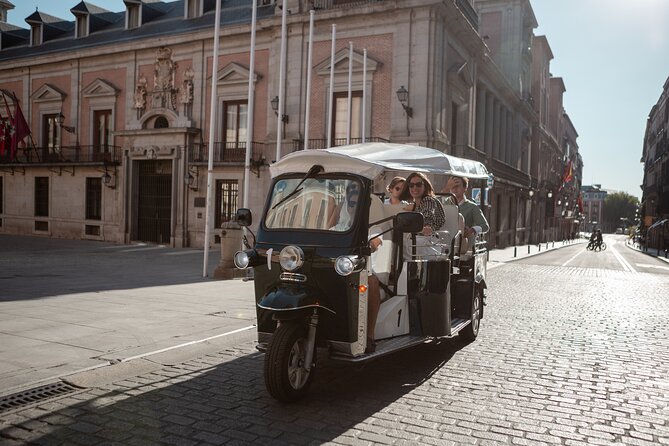
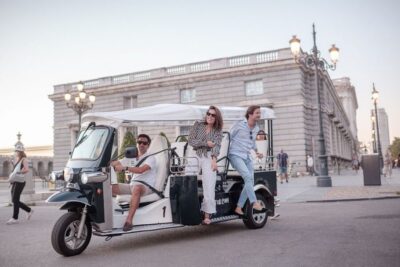
A tuk tuk can tame Madrid fast. This private, eco friendly ride is built for first-time orientation, with an electric vehicle and a local guide shaping the day around what you actually want to see.
I love the 100% electric eco tuk tuk setup, because you get close to the city without the hassle of big bus logistics. It is also private for your group, so the guide can answer your questions as you go, not after a crowd shuffle.
One thing to consider: the open top can make it harder to look straight up at tall facades, and very hot weather can feel intense in a small vehicle. Winter blankets help a lot, but you still want to dress smart for the day.
In This Review
- Quick takeaways before you book
- How the eco tuk tuk express gets you moving from Plaza de Oriente
- Mercado de San Miguel and the best kind of first impression: food, crowds, and style
- Atocha station: Madrid’s busiest hub, explained in plain human terms
- Palacio de las Cortes: where architecture meets political power
- Cibeles and Neptune: Madrid’s sports rivalry, turned into city art
- Prado museum area: major European painting without the full museum day
- Los Jerónimos (San Jerónimo el Real): a church that feels royal even when you miss the details
- Puerta de Alcalá: neoclassical grandeur and a fast, memorable landmark
- Banco de España area: impressive exterior, with limits on what you can see inside
- Plaza de Santa Ana to Almudena Cathedral: the city shifts gears toward faith
- Palacio de Oriente: royal Madrid at the finish line
- Value check: why this tour earns its spot on a tight schedule
- When a 1 to 4 hour ride makes sense in your Madrid plan
- Should you book the Eco Tuk Tuk Madrid Express?
- FAQ
- How long is the Madrid Express tour?
- Is it a private tour?
- What’s the meeting point and how do I find it?
- Does the tour include blankets or rain protection?
- Do I need hotel pickup?
- What should I know about delays or schedule changes?
- Can I cancel for a refund?
Quick takeaways before you book
- Eco-friendly electric ride, private for your group so you can ask questions and set the pace.
- Winter blankets and protective layers make cold or breezy weather much more comfortable.
- Pre-selected photo stops keep the timing tight and reduce wandering.
- Top-sight route for a fast orientation of central Madrid.
- Guides like Juan, Esther, and Carlos are repeatedly praised for clear English and friendly, story-based commentary.
- Views upward are limited a bit by the tuk tuk design, so expect to angle around for photos.
How the eco tuk tuk express gets you moving from Plaza de Oriente
This tour starts near Madrid’s Royal Palace area, at the bus station (underground) by Plaza de Oriente, right by the Puerta del Príncipe entrance. The address you’ll see is Calle Bailén, 4, but the practical tip is to search for Calle Bailén 4 or Puerta del Príncipe on Google Maps, then look for the Eco Tuk Tuk signage and follow the stairs to the station.
You do not need to find parking, and you are not waiting in lines. The point is speed plus comfort, using short vehicle-to-stop segments so you can see more of the center without spending your whole day stuck in transit.
How long is it? The listing says about 1 to 4 hours, and the express feel is real. Even if you pick a shorter option, you should expect a structured route with photo moments, not a slow scenic drift.
Finally, capacity matters. Tuk tuks are reserved privately, and the legal max is 4 passengers per tuk tuk. If your group is bigger, you may use more than one vehicle so you still stay together.
More Private Tours in Madrid
- Madrid: Private City Tour by Eco Tuk Tuk
★ 4.9 · 3,465 reviews - Madrid Welcome Tour with Local Guide in Eco Tuk Tuk Private
★ 5.0 · 2,936 reviews - Madrid Historical Tour with Local Guide in Eco Tuk Tuk Private
★ 5.0 · 876 reviews - Toledo Private Tour with Licensed Guide and Driver from Madrid
★ 5.0 · 637 reviews
Mercado de San Miguel and the best kind of first impression: food, crowds, and style
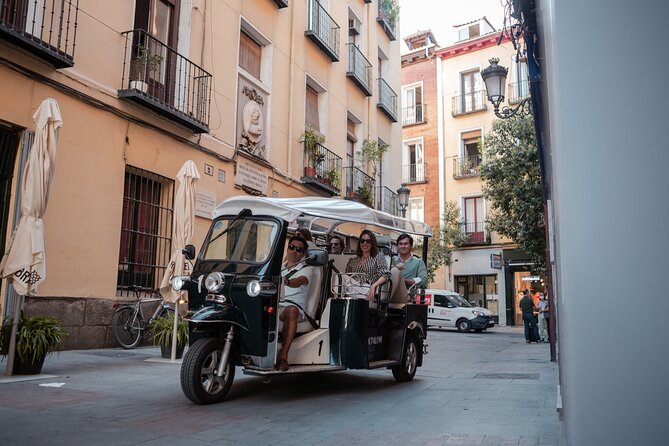
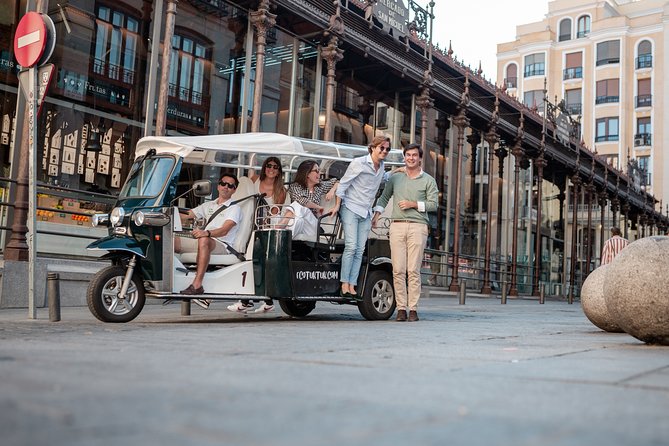
Your route kicks off at a place that makes Madrid feel like Madrid. The stop description matches Mercado de San Miguel, which opened in May 1916 as a food market and later evolved into Madrid’s early “gastronomic market” identity. The modernization is part of why this stop works on an express tour: even if you do not go inside, you get that immediate sense of the city’s appetite for food culture and design.
What I like here is the contrast. You get a classic landmark vibe fast, then the tour moves on to big-city power points like stations, government buildings, museums, and churches.
If you plan to snack, this is a natural place to start thinking about what you want to try later. Just keep your time expectations realistic. On an express tour, this is about placement and orientation, not a full market detour.
Atocha station: Madrid’s busiest hub, explained in plain human terms
Next up is Atocha station, a huge railway complex near Plaza del Emperador Carlos V that serves as the country’s busiest station and one of Europe’s main hubs. Even without going deep into timetable details, the stop matters because Atocha is Madrid’s “gravity well.” It helps you understand why certain streets feel like they funnel people into the center.
This is also where a good guide makes a difference. The guides on this program are often praised for clear English and for turning facts into a story you can picture later, with names like Juan and Esther showing up in the provided guide highlights. You’ll leave with mental arrows that connect neighborhoods.
Practical note: Atocha is lively. In the middle of an express route, it is smart to use photo moments efficiently and let the guide lead the next turn.
Palacio de las Cortes: where architecture meets political power
From transport to governance. The tour includes the Palace of the Spanish Courts, built on the site of the former convent of the Holy Spirit. That history is not just trivia. It explains why the building feels layered, as if Madrid kept rewriting itself on top of older meanings.
The facade details you’ll hear about include the neoclassical porch with six Corinthian columns, the triangular pediment with reliefs, and the lion sculptures flanking the entrance, said to be cast using iron from captured cannons. The tour also notes that the bronze door opens only on very marked occasions, which is a fun reality check that this is a working institution, not a theme park.
What you can realistically do here on an express ride is look, photograph, and absorb. This is an “eye candy plus context” stop.
A few more Madrid verdicts worth reading
- Madrid: Highlights City Tour by Electric Tuk Tuk★ 4.7 · 346 reviews
- Madrid: City Highlights Tuk Tuk Tour★ 4.4 · 334 reviews
- Tour Welcome Barcelona with Local Guide in Eco Tuk Tuk Private★ 5.0 · 1,882 reviews
Cibeles and Neptune: Madrid’s sports rivalry, turned into city art
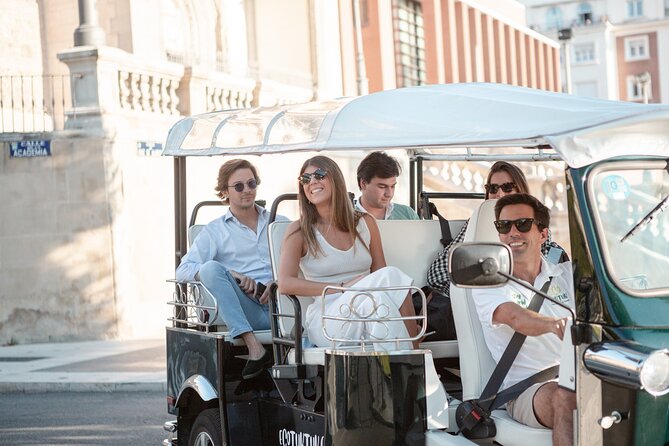
Then you get to one of Madrid’s most photogenic scene-setters, the civic space where mythology and sports fandom shake hands.
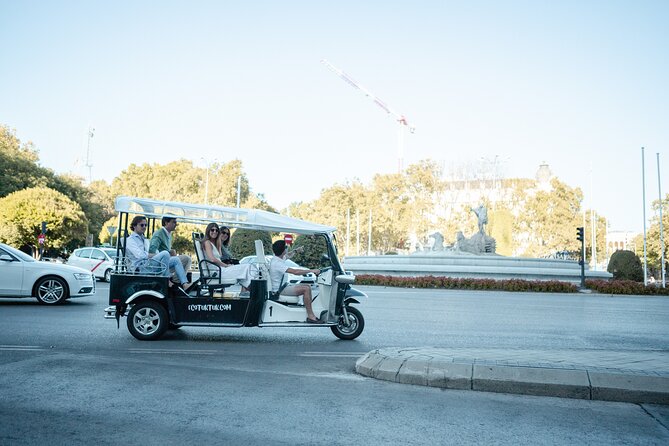
The route description connects the gods Cibeles and Neptune, explaining how their sources were originally set up facing each other on the Paseo del Prado side, then later moved to the centers of the Cibeles and Cánovas del Castillo squares. In other words, the city’s planning shaped the way people experience the statues.
The guide angle here is what makes this work. Madrid can feel abstract until you know what people gather for. The description makes the connection clear: Atlético de Madrid celebrates victories at the square of Cibeles while Real Madrid’s fans do the same around Neptune.
If you enjoy street-level context, this stop helps you read Madrid beyond buildings. You start noticing which plazas are for rituals, not just sightseeing.
Prado museum area: major European painting without the full museum day
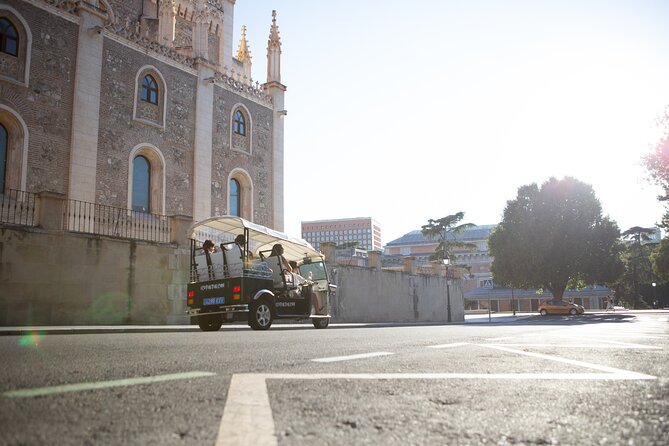
Next is a big art stop: the Museo del Prado. The description calls it one of the most important museums for European painting, and it lists the heavyweight names you know, including Velázquez, El Greco, Goya, plus Titian, Rubens, and Bosch. The point for an express tour is not to see every gallery. It is to stand in the orbit of the museum and understand why people plan trips around it.
On this tuk tuk route, you’ll likely experience the Prado area as part of the visual sweep and photo strategy. You get the “I am here” moment, then you keep moving.
If your schedule allows, you can pair this tour with a separate museum ticket later. The express route sets the mood and helps you decide what you actually want to see in depth.
Los Jerónimos (San Jerónimo el Real): a church that feels royal even when you miss the details
Just near the Prado area, the tour includes San Jerónimo el Real, popularly known as Los Jerónimos. It is described as late Gothic with Renaissance influences from the early 16th century, and the important practical note is that the original building has been remodeled and restored many times.
The connection to Spanish monarchy is also front and center. Built by order of the Catholic Monarchs, it became a spiritual retreat for monarchs over time, and it has served royal functions, including royal weddings and investitures in the absence of a cathedral.
Why this matters for you: you are going to get a sense of Madrid’s religious and political layers in one pass. Even if you do not go inside, your guide can point out what to notice.
Puerta de Alcalá: neoclassical grandeur and a fast, memorable landmark
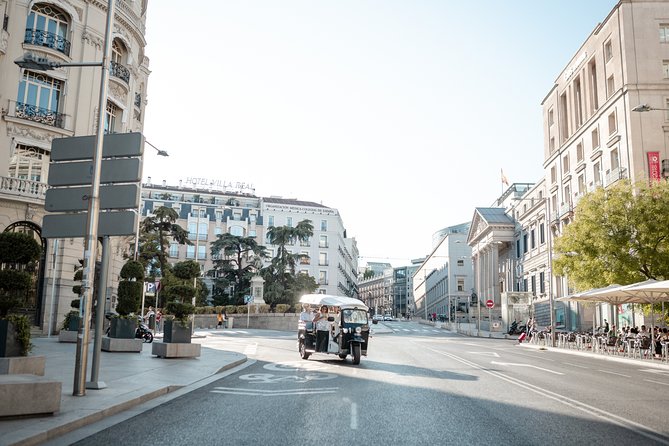
Then comes one of Madrid’s most recognizable “stop-and-smile” landmarks: the Puerta de Alcalá. This is described as a granite neoclassical triumphal arch designed by Francesco Sabatini, inaugurated in 1778 on the order of Carlos III to replace an earlier gate.
The description gives you a key detail that makes it feel special: it has five openings instead of the usual three. The two decorated sides also matter. The tour notes that the inner face is simpler, while the exterior has richer decoration, the kind early visitors would have noticed as they entered Madrid.
This is the kind of stop that works even for short attention spans. You will probably want photos at eye level, then step back and look at the whole structure. The arch is also a good way to measure distances in the city center, because Madrid’s monuments keep relating back to big boulevards.
Banco de España area: impressive exterior, with limits on what you can see inside
The route also includes the Banco de España building. The description points out its decorative over-the-top feel, and it explains the purpose: to give the national bank a seat that matched its importance, like coin and bill issuance across Spain.
One important practical reality is included in the description: the interior can only be visited by groups from educational centers and universities, and only exceptionally by non-profit cultural or associative entities. For you, on an express tour, this stop is about seeing the exterior and letting the guide tell you what the building was meant to represent.
This is where the guide’s storytelling helps. Otherwise, it is just a fancy facade. With context, it becomes a snapshot of Spain’s financial power and national identity.
Plaza de Santa Ana to Almudena Cathedral: the city shifts gears toward faith
From civic power and banking, the tour moves into more intimate Madrid space, including Plaza de Santa Ana in the Cortes neighborhood. The listing says the square dates to 1810 and has been shaped by repeated urbanization phases, with varying levels of success. That kind of detail helps you read Madrid’s streets as evolving, not frozen.
Then the route heads to Almudena Cathedral, described as Madrid’s most important religious building and consecrated in 1993 by Pope John Paul II as the first consecrated cathedral outside Rome. The stop also references the cathedral museum, with mosaics and diocese objects across multiple rooms.
As an express visitor, you may not have time for full museum coverage, but the stop itself gives you the big visual anchor. You see a modern consecrated cathedral that still feels deeply tied to Madrid’s spiritual identity.
Palacio de Oriente: royal Madrid at the finish line
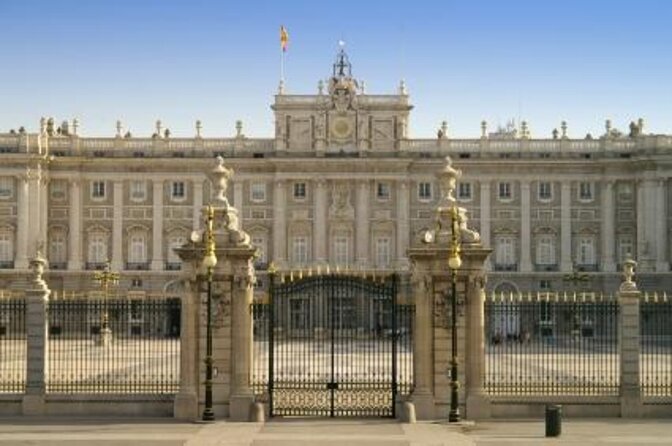
The tour’s arc lands in royal territory with the Royal Palace of Madrid, also known as Palacio de Oriente. The description notes the palace began in 1738, with works lasting 17 years. It also says that Carlos III established his habitual residence there in 1764.
You’ll also hear about the earlier palace predecessor, the Palace of the Austrias, destroyed by fire in 1734, and how the royal site location carried forward.
The palace surroundings are part of the picture too. The route description mentions the Campo del Moro gardens to the west, with roots going back to the Middle Ages, and the Sabatini gardens created in the twentieth century to the north. The listing says Campo del Moro can be visited during the day, but on the express tour you should assume you will experience the gardens mainly from the outside or in short viewing windows.
For me, this ending makes sense because you start near the palace area and you finish with the “why it matters” view. It leaves you with a crisp final image.
Value check: why this tour earns its spot on a tight schedule
At $28.67 per person, this express tour sits in the “smart use of time” category. You are paying for three things that are hard to DIY quickly:
- Transportation through central Madrid in a small eco electric vehicle that can move through tight areas where big buses may not be as practical.
- A local guide who connects dots, not just names places. The provided guide highlights repeatedly mention drivers like Carlos and Lucia doing a jam-packed ride with historical facts, plus Fernando and David steering the commentary with friendly explanations.
- Comfort extras that make the route doable in less than perfect weather, like blankets and protective layers in winter.
It is also private, so your group is not stuck listening to a prerecorded script or waiting for a mass pile-up at each stop. One common reason this kind of experience beats a typical hop on, hop off approach is simple: you can ask your own question mid-route and get an answer right away.
Do note the trade-off. Express means short stops. If you want long museum time or a deep dive into one building, you’ll need to add separate visits.
When a 1 to 4 hour ride makes sense in your Madrid plan
This is ideal if you are in Madrid for a short stay, or you want your first day to feel like a clean map in your head. It is also good after an overnight flight, because it gives you context fast without forcing you into a full day of walking right away.
It works well for:
- First-time visitors who need orientation across the center.
- Families who want a fun ride with explanations. The provided information includes a family scenario with kids ages 6 and 8, and it notes that kids can understand the guide’s material during the ride.
- Older visitors who may appreciate the vehicle design and driver help getting on.
The tour also has clear participation rules. Minimum age is 2 years, and babies are not allowed. There’s also a minimum weight requirement of 9 kg. Pets are not allowed.
Should you book the Eco Tuk Tuk Madrid Express?
Book it if you want a fast, comfortable way to see central Madrid and you like your sightseeing with context. I especially like that you get electric transport, winter comfort gear, and fixed photo stops so you are not wasting time guessing where to stand.
Skip it or think twice if you are sensitive to heat or you care a lot about upward views of tall architecture. The tuk tuk layout can limit straight-on perspectives, and on very hot days the ride can feel uncomfortable.
If your goal is simple, get oriented and start building your Madrid “where next” list, this tour is a strong choice. Pair it with one or two longer ticketed sights afterward and you get the best of both worlds.
FAQ
How long is the Madrid Express tour?
The duration is listed as approximately 1 to 4 hours, depending on the option you book.
Is it a private tour?
Yes. It is a private tour/activity, so only your group participates. Tuk tuks are reserved based on the group size, with a legal maximum of 4 passengers per tuk tuk.
What’s the meeting point and how do I find it?
The meeting point is C. de Bailén, 4, Centro, 28013 Madrid, near Plaza de Oriente. The instructions say to search for Calle Bailén 4 or Puerta del Príncipe on Google Maps, then look for the Eco Tuk Tuk signage. The pickup point is at the underground bus station by the Royal Palace.
Does the tour include blankets or rain protection?
Yes. Included items specify blankets and protective layers against rain and wind to avoid cold weather.
Do I need hotel pickup?
No. The listing states hotel pickup and drop-off is not included.
What should I know about delays or schedule changes?
If you are delayed, the activity may be reduced according to lost time, and the route could change. If your delay is longer than 15 minutes, the activity is canceled and there is no refund. The itinerary may also vary due to closed streets or demonstrations.
Can I cancel for a refund?
Yes. You can cancel for a full refund up to 24 hours in advance of the experience start time. Changes within 24 hours are not accepted.
Latest Madrid reviews into the ledger



Private Tours in Madrid, compared.
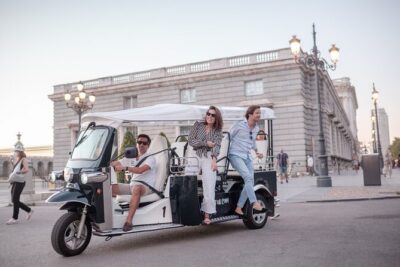
Madrid Welcome Tour with Local Guide in Eco Tuk Tuk Private
Read our review →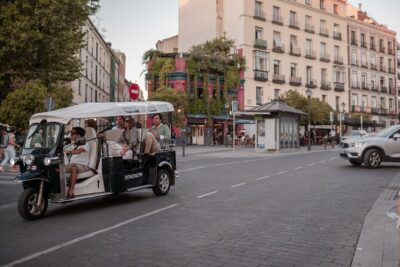
Madrid Historical Tour with Local Guide in Eco Tuk Tuk Private
Read our review →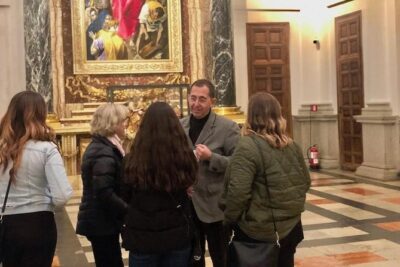
Toledo Private Tour with Licensed Guide and Driver from Madrid
Read our review →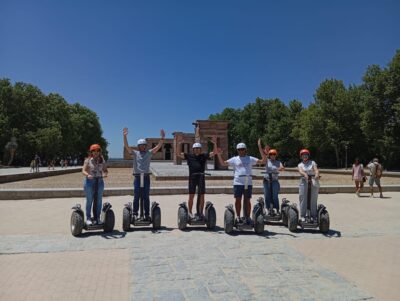
Madrid Private Segway tour. Retiro Park – Centro Historico
Read our review →
Madrid Barajas Airport Private Transfer To Madrid City
Read our review →
Segway Private Tour in the Historic Center of Madrid
Read our review →Browse the lists this tour appears in