
Reviewed · PRIVATE TOURS IN MADRID
Madrid Expert Tour with Local Guide in Eco Tuk Tuk Private
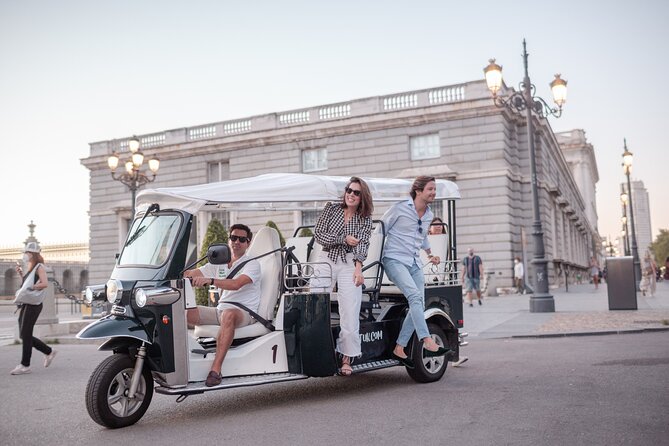
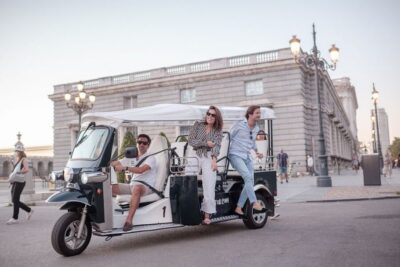
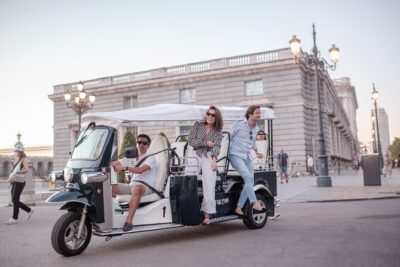
Skip lines, zip Madrid in an eco tuk-tuk. This is a fun, private way to get oriented fast, with an electric vehicle and a guided route that hits both grand classics and city power points. I like the fixed photo stops and no-queue start, but one drawback is that you cannot change the route or linger exactly where you want.
The route works because it pairs quick rides with just enough stops to understand where things are, not just to collect photos. Guides like Jaime, Lucia, Carlos, Gustavo, and Manuel are repeatedly praised for keeping the pace easy, the explanations clear, and the humor up when you want a breather.
In This Review
- Key things to know before you ride
- Why an eco tuk-tuk is a smart first-day plan
- Meeting at Puerta del Príncipe (Plaza de Oriente area)
- The opening loop: Mercado area, Atocha, and Spain’s working center
- Prado time without the stress: Neptune Fountain and San Jerónimo el Real
- Puerta de Alcalá, Salamanca streets, and the money corridor
- Bernabéu to Columbus to Villa Fernán Gómez: modern Madrid icons
- National Library, Cibeles, and the Bank of Spain exterior power play
- Plaza Santa Ana, San Francisco el Grande, and Almudena Cathedral
- Royal Palace area and Campo del Moro: when Madrid turns cinematic
- Templo de Debod: the free 15-minute “wait, what is this?” stop
- What to bring, and how to time your day with a 2 to 4 hour tour
- Price value: is $28.67 per person worth it?
- Who this eco tuk-tuk tour fits best (and who should think twice)
- Should you book the Madrid Expert Tour in Eco Tuk Tuk?
- FAQ
- How long is the Madrid eco tuk-tuk tour?
- Is the tour in English?
- Is this a private tour?
- What is included in the price?
- What is not included?
- Where do I meet the tour?
- Are there age or body-size requirements?
- Are pets allowed?
- Does the tour run in bad weather?
- How many people can ride per tuk-tuk?
Key things to know before you ride
- Private tuk-tuk for your group: only your party rides, so the day feels less crowded.
- Electric and built for comfort: 100% electric, with drivers ready to help older riders get on.
- Fixed photo stops, no detours: you get planned viewpoints, but you cannot modify stops on the fly.
- Winter blankets included: protective layers help you stay outside longer when it’s cold or windy.
- A route that teaches Madrid’s layout: old center, museum core, and the modern north corridor all show up.
- Good for a first day: you’ll learn what to prioritize later, including where to plan extra time.
Why an eco tuk-tuk is a smart first-day plan
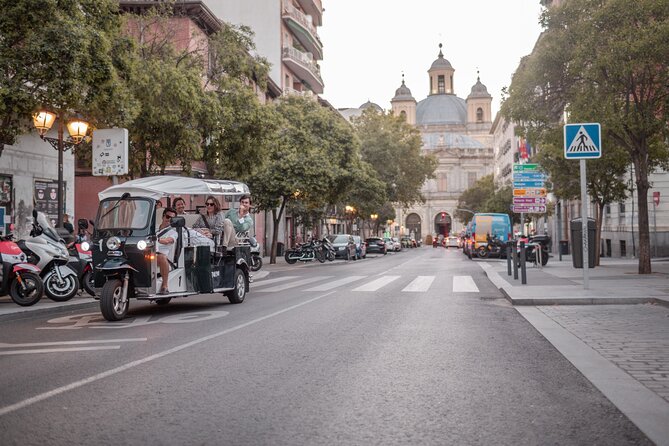
Madrid can feel like three cities at once: the formal, the historical, and the modern. This tour’s big win is that it gives you a usable map in just a few hours, with ride time that beats backtracking on foot.
You also start with less friction. The experience is designed to begin without queues or waiting, and you get a local companion in the expert role, not just a driver who points in the general direction.
If you have limited time, or your day starts with tired legs, this is a practical way to see the major anchors of the city and then decide what deserves your next walk. The tuk-tuk format is especially handy for older people, families with kids who can handle short segments, and anyone who wants to keep the day moving.
More Private Tours in Madrid
- Madrid: Private City Tour by Eco Tuk Tuk
★ 4.9 · 3,465 reviews - Madrid Welcome Tour with Local Guide in Eco Tuk Tuk Private
★ 5.0 · 2,936 reviews - Madrid Historical Tour with Local Guide in Eco Tuk Tuk Private
★ 5.0 · 876 reviews - Toledo Private Tour with Licensed Guide and Driver from Madrid
★ 5.0 · 637 reviews
Meeting at Puerta del Príncipe (Plaza de Oriente area)
Your pick-up is right by the Royal Palace area, which helps because you start close to the action. The meeting point is listed at C. de Bailén, 4, Centro, and the practical instruction is to search for Calle Bailén 4 or Puerta del Príncipe on Google Maps.
The real detail that matters: the pick-up is at the underground bus station of Plaza de Oriente, next to the Royal Palace. There is a note about stairs to access the station, and an Eco Tuk Tuk sign to guide you once you arrive.
If stairs are an issue, you should contact the team by phone or WhatsApp (+34 696 99 78 89) or email ([email protected]) so they can help you access the meeting point by elevator. It’s also worth knowing the staff helps people get on when needed, which is a big deal if you are traveling with someone who doesn’t love steps.
The opening loop: Mercado area, Atocha, and Spain’s working center
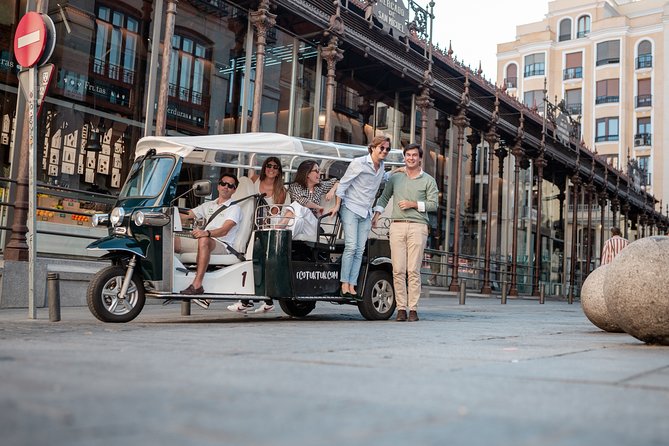
The first stops are chosen for orientation and contrast. You start at a covered market dating from around 1916, where you get a feel for how Madrid shops and eats day-to-day. Even if you do not plan a full meal here, it’s a great place to notice the mix of local food and delicatessen energy.
Next up is Atocha, one of Madrid’s biggest railway complexes and a major hub in Spain, busy both in real life and in the way it shapes the city. Seeing it early helps you connect neighborhoods to transport routes, and it also gives you a sense of scale, since Atocha is not a small station with one vibe. It’s a whole piece of urban life.
Then you swing toward the Palace of the Spanish Courts, the building that once used the site of the former convent of the Holy Spirit. Even from outside, this is a strong stop because it explains Madrid’s political backbone, with neoclassical features that feel formal and deliberate, including the famous stair and the columned façade.
A practical note: the buildings here are grand, but your time is limited. Treat these as “see it, understand it, photograph it” moments, not long sightseeing sessions, so you do not burn the energy you need later for the museum and cathedral areas.
Prado time without the stress: Neptune Fountain and San Jerónimo el Real
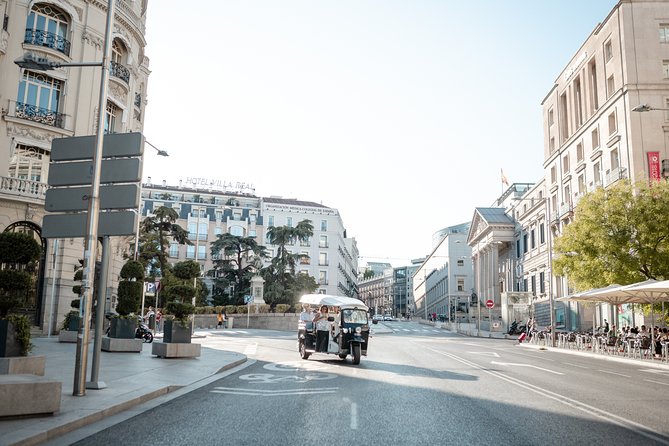
This tour’s museum-zone strategy is smart: it places you around the Prado area and then layers in context.
You’ll pass the Neptune Fountain in Plaza de Cánovas del Castillo, a classic neoclassical roundabout centerpiece. It’s also a useful reference point. Once you know where Neptune sits, you understand how the museum area connects to wider boulevards.
Then you reach the museum core. The stop is described as Madrid’s key European-painting destination, with major works spanning the 16th to 19th centuries, and a strong presence from artists like Velázquez, El Greco, and Goya. You will not be doing a full “paintings marathon” in a short tour, but you do get the map of what matters.
Right nearby is San Jerónimo el Real, a late Gothic church with Renaissance influences. This is the kind of stop that makes your tour feel real, not just scenic. You get the sense that Madrid’s religious and royal story sits in the same neighborhood as its museum identity.
My practical advice here: if you want to go inside the churches or plan a specific museum route later, decide quickly after your tuk-tuk drop-offs. This tour is the orientation tool, not the replacement for a full ticketed visit.
A few more Madrid verdicts worth reading
- Madrid Express Tour with Local Guide in Eco Tuk Tuk Private★ 5.0 · 413 reviews
- Madrid: Highlights City Tour by Electric Tuk Tuk★ 4.7 · 346 reviews
- Madrid: City Highlights Tuk Tuk Tour★ 4.4 · 334 reviews
Puerta de Alcalá, Salamanca streets, and the money corridor
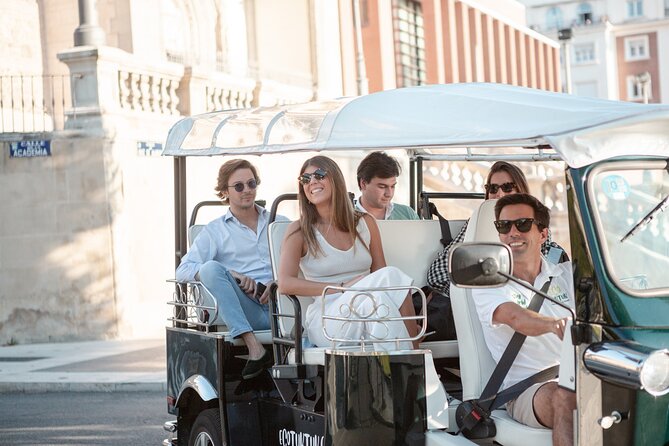
From the museum zone, the tour moves into the grandeur-and-affluence side of Madrid.
Puerta de Alcalá is a standout architectural moment. Built in neoclassical style and positioned along the road that led toward Alcalá de Henares, it has multiple openings and a richly decorated feel depending on which side you view. If you like comparing city monuments, this is a great one because it feels like a gateway with a story.
Then you drive through Barrio Salamanca, focusing on major streets like Velázquez, Ortega y Gasset, and Serrano. This is Madrid’s upscale rhythm, where storefronts and urban design signal a different pace than the old center. It’s not just about shopping windows, either. The wide boulevards and feel of the area help you picture where modern Madrid life happens.
For first-timers, this section is valuable because it gives you a clear mental split: where the formal historic sights are versus where the city’s business and stylish energy concentrates.
Bernabéu to Columbus to Villa Fernán Gómez: modern Madrid icons
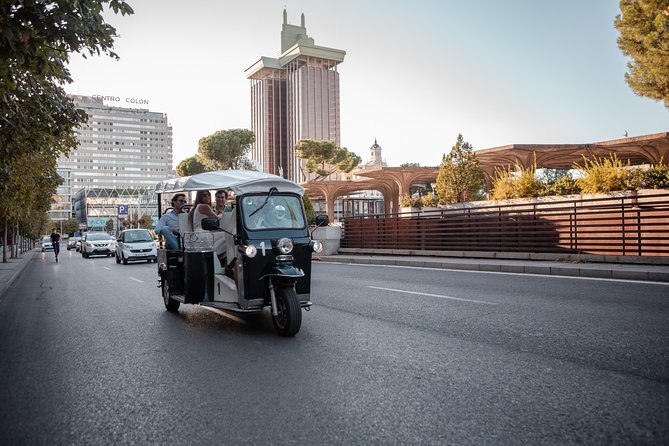
The tour hits Santiago Bernabéu, the stadium inaugurated in 1947, with a current capacity listed at 81,044 spectators. Even if you are not a match-day person, it’s a strong cultural landmark in Madrid’s modern identity. Seeing it from the route also helps you understand why locals talk about the area as a major hub.
From there you continue along Paseo de la Castellana toward the Christopher Columbus monument. This white marble neo-Gothic sculpture and its pedestal dominate the square, with the monument set at the center of the traffic roundabout. The “wow” is immediate, but your best experience here is using it as a visual bookmark.
Nearby is the Gardens of Discovery, opened in 1970, where you can view sculptures tied to exploration themes. If you want a breather between stops, this is the kind of pause that makes the day feel less like a checklist.
You also pass through the area around the Cultural Center of Villa Fernán Gómez, a useful “cultural Madrid” marker even if you do not stop inside.
National Library, Cibeles, and the Bank of Spain exterior power play
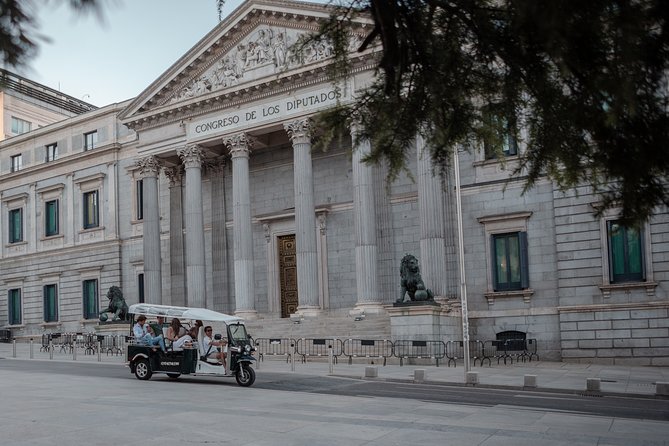
This stretch gives you Madrid in institutional form.
The National Library of Spain is described as responsible for preserving Spain’s bibliographic and documentary heritage, with tens of millions of publications under its custody. The tour framing makes sense here: you’re shown where the museum and exhibition halls connect, so you understand it’s not only a library, it’s also a cultural display point.
Then you reach Cibeles, home to the famous fountain with the Roman goddess Cibeles and a lion-car scene. If football fandom is part of your trip, this is part of the city’s public celebration language. Either way, it’s a classic photo stop because the fountain is built to be seen from all sides.
You also pass the National Bank of Spain building area, noted as a monumental structure tied to the National Bank’s role and built to match the importance of that function. The interior is not generally open to casual individual visits based on the provided info, but the exterior is still worth noting because it signals Madrid’s strength architecture.
Practical takeaway: this section shows you the city’s “big systems,” transport, knowledge, finance, and public monuments. It’s the kind of perspective that makes your later self-guided walks feel smarter.
Plaza Santa Ana, San Francisco el Grande, and Almudena Cathedral
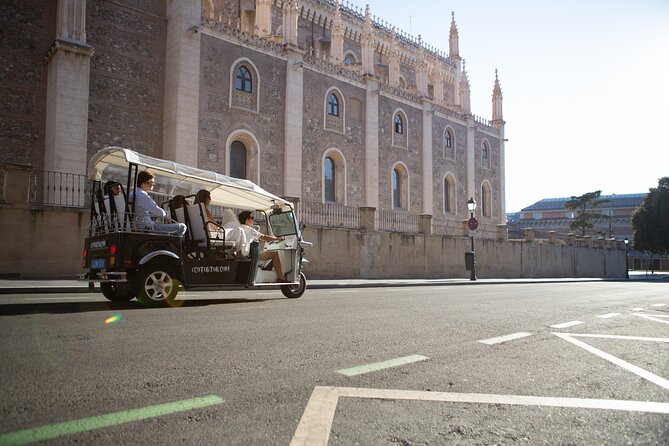
As the route moves back toward the historic core, it keeps the stops meaningful rather than random.
Plaza de Santa Ana is an open square that dates to 1810. It’s the sort of space where you can imagine the city’s daily life, with urban changes shaping how it looks today.
Then you see the Royal Basilica of San Francisco el Grande, officially Basilica of Our Lady of the Angels. This is a major Catholic landmark in central Madrid. It’s also a great example of how the city’s religious buildings are not tiny side streets. They are big focal points that shape neighborhoods.
The tour continues to Almudena Cathedral, described as Madrid’s most important religious building and consecrated in 1993 by Pope John Paul II. The information also notes a museum that tells the story of the diocese, which gives you a clue that there is more than one way to experience this stop.
If you want the full cathedral experience, I’d plan to go in on a day when you have extra time. On this tuk-tuk format, you’re mainly there for orientation and the ability to decide what to revisit.
Royal Palace area and Campo del Moro: when Madrid turns cinematic
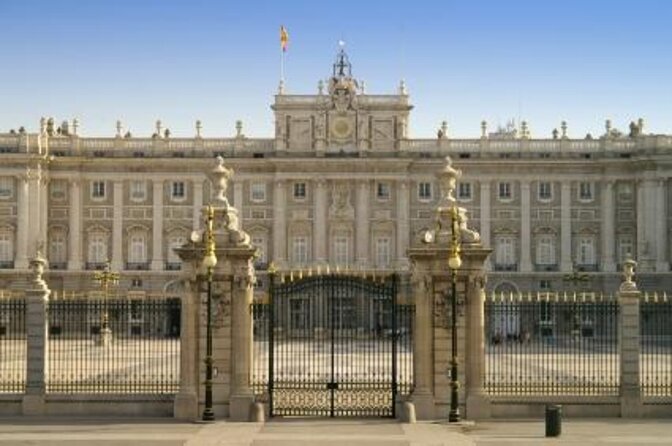
The Royal Palace, also called Palacio de Oriente, is used for receptions, ceremonies, and official events. The construction dates start in 1738 with works lasting about 17 years, and Carlos III established his habitual residence there after completion.
Even if you do not go inside, the palace area is a powerful scene because it is designed to be seen. The Campo del Moro gardens extend along the palace side, while the Sabatini gardens are also part of the surroundings and described as created in the 20th century.
Campo del Moro is noted as historically protected and spans about 20 hectares, extending from the western façade of the Royal Palace to the promenade of the Virgin of the Port. This gives you a concrete sense that Madrid did not just stack buildings. It carved out breathing space right beside them.
Small planning tip: if you want to cool down with shade or simply escape the sidewalk crowd for 20 to 30 minutes, the palace gardens are a strong choice. Use the tuk-tuk tour to learn where that escape is located.
Templo de Debod: the free 15-minute “wait, what is this?” stop
One of the most interesting later stops is Templo de Debod, an ancient Egyptian temple building relocated to Madrid. It’s located west of Plaza de España, near the Paseo del Pintor Rosales, on a hill area where Mountain Barracks was located.
The tour notes that the admission ticket is free and the stop is about 15 minutes. That combination is rare in big cities: a short, easy cultural moment you can actually afford and actually complete.
This is also a smart mental reset. After palaces and cathedrals, it reminds you that Madrid’s story is not locked in one time period.
What to bring, and how to time your day with a 2 to 4 hour tour
Even though this tour is structured, Madrid weather can still surprise you. The experience runs in rain or heat, and blankets and protective layers are included to help you stay comfortable.
So pack like you’re riding outside. Bring sunscreen, water, and a hat for sunny days. If you’re visiting in winter, the provided blankets are helpful, but you should still dress in layers so you can adjust when the sun appears.
Because the stops are planned and photo stops are fixed, you get the best experience when you arrive with a clear goal: understand Madrid’s layout and pick 2 to 3 places you want to return to.
Price value: is $28.67 per person worth it?
At $28.67 per person, the value comes from what you avoid and what you gain.
You gain:
- a private setup for your group, not a mixed public scramble
- an expert local companion and driver
- a 100% electric vehicle
- planned photo stops and a route that hits the city’s key landmarks
- no-queue start, which matters if your time is limited
You avoid:
- spending your first hours figuring out how to get from one big sight to another
- wasting energy on back-and-forth transport when Madrid streets can be busy
The duration is listed as about 2 to 4 hours, and the tour is commonly booked around a month in advance. That usually signals demand from people who want a fast orientation. If you want a “see the highlights” day that still feels guided and local, this price point can make sense fast.
The main tradeoff is the lack of stop flexibility. You are not buying a wandering, stop-anywhere experience. You are buying a focused route that works.
Who this eco tuk-tuk tour fits best (and who should think twice)
This tour is a strong fit if you:
- are visiting for the first time and want a quick city orientation
- have kids or teens who do not want long stretches of walking
- want a comfortable option for older family members
- prefer a guided narrative rather than reading plaques all day
- want an easy start day before you plan the Prado or palace on your own time
You might think twice if you want:
- lots of free time at one monument
- control to linger in a single place for hours
- a choose-your-own-adventure route that changes with your mood
The fixed photo stops and set itinerary are not a flaw. They are the point. They keep the tour efficient.
Should you book the Madrid Expert Tour in Eco Tuk Tuk?
Book it if you want a fast, comfortable Madrid primer with a guided backbone. It’s especially worth it as a first activity, because the landmarks along the way help you plan your next day with less guesswork.
I would skip it only if your priority is deep time at one site, like spending most of your day inside a single museum or lounging around one square for hours. In that case, you might be happier with a museum-focused plan and a separate, slower walking day.
If you book, do this: wear sun and rain-friendly layers, bring water, and treat the tuk-tuk stops as your “Madrid map lessons.” Then go back on your own to the 2 or 3 places that genuinely pull you in.
FAQ
How long is the Madrid eco tuk-tuk tour?
It runs for about 2 to 4 hours, with the tour taking roughly around three hours.
Is the tour in English?
Yes, it is offered in English.
Is this a private tour?
Yes. It is private, and only your group participates.
What is included in the price?
The experience includes an expert companion guide and driver, a private vehicle for your group, a 100% electric and sustainable vehicle, pre-selected stops for photographing, and blankets/protective layers against rain and wind.
What is not included?
Tips to the driver guide are not included. Hotel pickup and drop-off and transfers outside the tour route are also not included.
Where do I meet the tour?
The start point is C. de Bailén, 4, Centro, 28013 Madrid. The pick-up is at the underground bus station of Plaza de Oriente next to the Royal Palace, and the directions reference Puerta del Príncipe.
Are there age or body-size requirements?
Yes. The minimum age is two years old, and babies are not allowed. There is also a minimum weight requirement of 9 kg.
Are pets allowed?
No, pets are not allowed for security reasons.
Does the tour run in bad weather?
Yes, tours take place in rain or heat. Cancellation only happens under extreme conditions.
How many people can ride per tuk-tuk?
The tuk-tuks are reserved privately, and the legal maximum is 4 passengers per tuk-tuk.
Latest Madrid reviews into the ledger



Private Tours in Madrid, compared.
Madrid Welcome Tour with Local Guide in Eco Tuk Tuk Private
Read our review →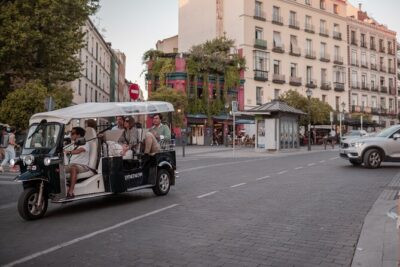
Madrid Historical Tour with Local Guide in Eco Tuk Tuk Private
Read our review →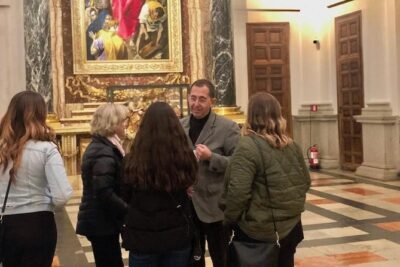
Toledo Private Tour with Licensed Guide and Driver from Madrid
Read our review →
Madrid Private Segway tour. Retiro Park – Centro Historico
Read our review →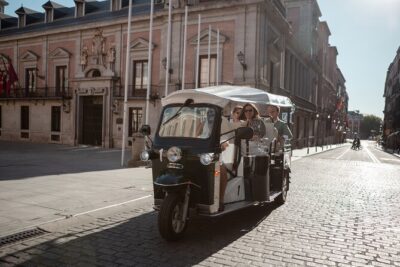
Madrid Express Tour with Local Guide in Eco Tuk Tuk Private
Read our review →
Madrid Barajas Airport Private Transfer To Madrid City
Read our review →
Browse the lists this tour appears in